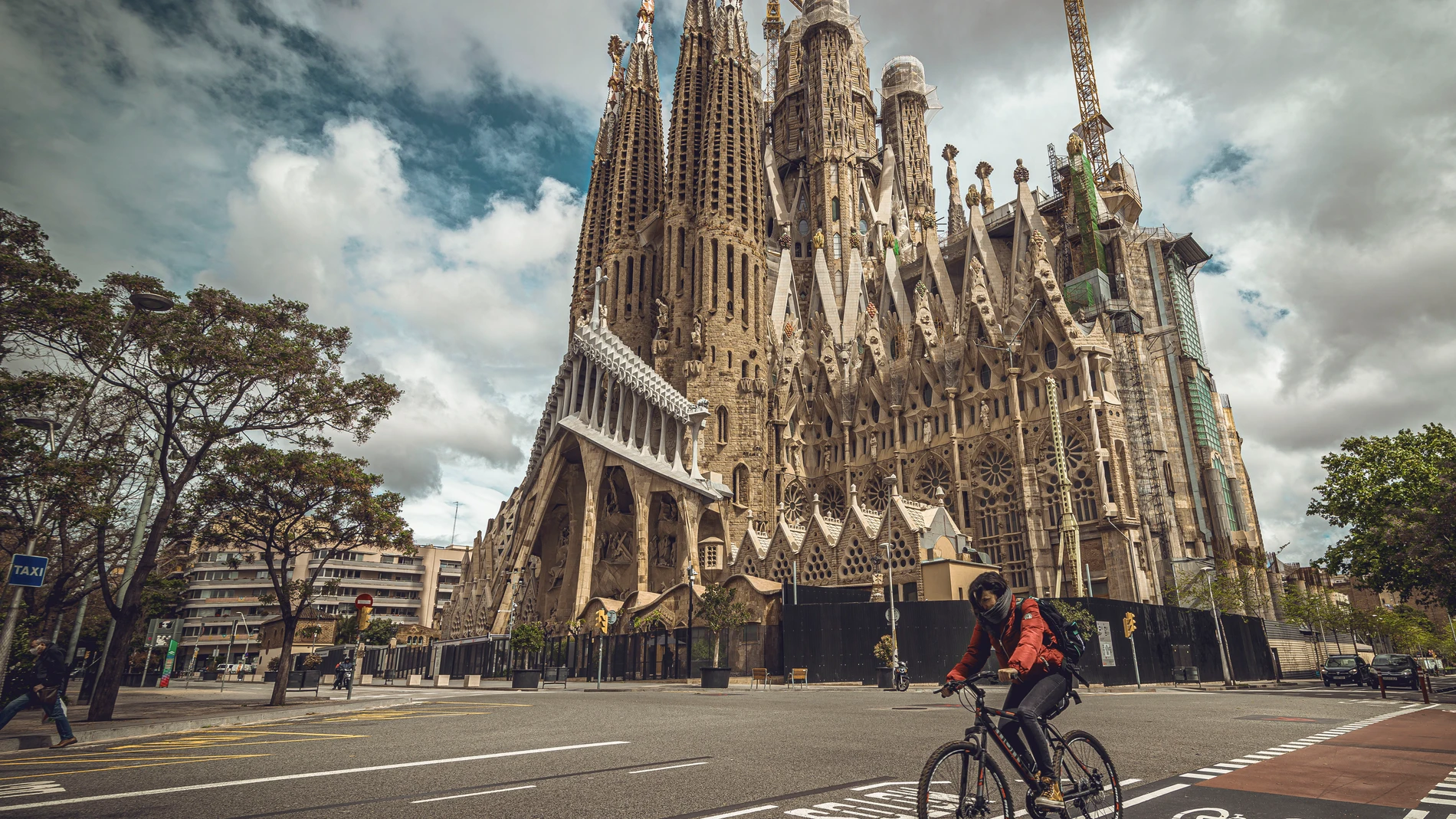
Introduction: Why the Sagrada Familia Calle Matters More Than You Imagine
Standing tall amid Barcelona’s rhythm, the Sagrada Família pulses with life beyond stone and spire. Not just visited but felt, its presence stretches past borders into global memory. Created by Antoni Gaudí, it pulls people close – year after year – with quiet force. Visitors arrive not only out of curiosity but because something ancient hums within its walls.
Still, there’s a detail plenty of tutorials miss
Found across multiple blocks, the Sagrada Familia isn’t pinned to just one road.
A full city block fits inside its walls, surrounded by roads that bring different views, ways in, moments. One street might greet you with noise, another stays quiet till noon. Corners shift light differently every hour. Each path around it tells a separate story.
- Sagrada Familia Street Layout Understanding
- Sidestep congested crowds
- Start where it fits best
- Save minutes here so you can wander later
- Capture superior photographs
- Navigate efficiently like a seasoned local
This big guide has over 3500 words and walks through every detail – exact roads, doorways, subway exits, how to get there on foot. Along the way, it shows secret spots and useful tricks only locals might know. Once finished reading, moving around Sagrada Familia feels smooth, almost natural.
Where Is Sagrada Familia Located in Barcelona?
The Sagrada Família is located in the Eixample district of Barcelona, renowned for its well-organized and modern urban layout.
Key Location Information
- City: Barcelona
- District: Eixample
- Region: Catalonia
- Country: Spain
Why This Location Is Significant
Eixample is distinguished by its grid-pattern streets, which make it:
- Easy to traverse
- Efficiently connected to public transportation
- Safer and more structured than older European city sections
Compared to cities like Rome or Paris, navigating Eixample is relatively effortless. Tourists benefit from straight avenues, predictable intersections, and logical signage—a stark contrast to more labyrinthine historic districts.
What Street Is Sagrada Familia On? (Truth Explained)
Here is a vital insight:
Sagrada Familia does not have a single street address.
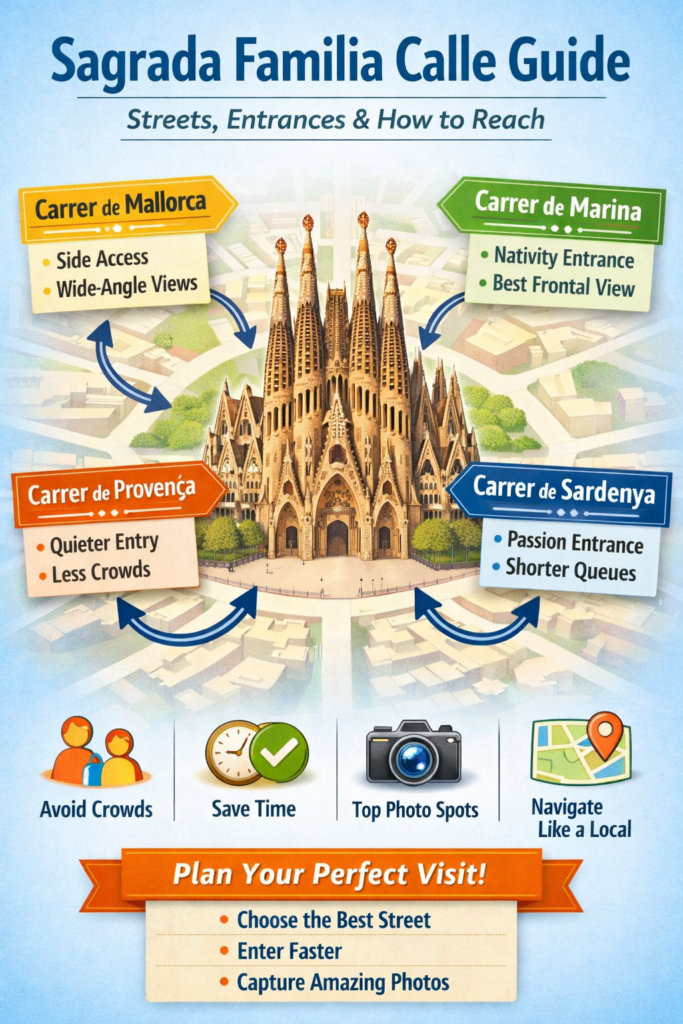
Rather, it spans a full city block, encircled by four primary streets.
Main Streets Surrounding Sagrada Familia
- Carrer de Mallorca
- Runs along one major side
- Often used as a reference point
- Provides spacious sidewalks for walking
- Carrer de Marina
- The most renowned street
- Offers the iconic frontal view of the basilica
- Leads to the Nativity façade
???? Most first-time visitors gravitate here.
- Carrer de Provença
- Quieter and less congested
- Ideal for relaxed entry
- Fewer tourists
- Carrer de Sardenya
- Access to the Passion façade
- Usually has shorter queues
- Easier entry during peak hours
Pro Tip: Understanding all four surrounding streets provides a strategic advantage in planning your visit and avoiding crowds.
Understanding the Entrances of Sagrada Familia
The basilica features multiple façades, each with distinct architecture and corresponding entrances.
Nativity Façade (Carrer de Marina)
- Designed by Antoni Gaudí
- Intricate and highly artistic
- Most frequented entrance
- Ideal for first-time visitors
Expect larger crowds during peak hours.
Passion Façade (Carrer de Sardenya)
- Minimalist, modern design
- Symbolizes the suffering of Christ
- Shorter lines
- Faster access
Recommended if you want a time-efficient visit.
Side Access (Carrer de Mallorca)
- Flexible entry for casual tourists
- Less crowded than Marina
- Functional and practical
Entrance Comparison Table
| Entrance | Street | Best For | Crowd Level | Architectural Style |
| Nativity Façade | Carrer de Marina | First-time visitors | High | Detailed & ornate |
| Passion Façade | Carrer de Sardenya | Quick entry | Medium | Modern & symbolic |
| Side Access | Carrer de Mallorca | Flexible entry | Medium | Functional |
How to Reach Sagrada Familia (Step-by-Step Guide)
By Metro (Most Convenient Option)
Barcelona’s metro system is world-class, fast, reliable, and easy to navigate.
Metro Lines:
- L2 (Purple Line)
- L5 (Blue Line)
Station: Sagrada Familia
Exit Tips:
- Choose exit toward Carrer de Marina
- Follow clear signs marked “Sagrada Familia”
This is usually the fastest and most efficient method to reach the basilica.
By Bus
- Numerous routes connect the city efficiently
- Offers scenic street-level views
- Useful if staying farther from the city center
By Walking
From central locations like Plaça de Catalunya:
- Distance: ~2.5 km
- Duration: 25–30 minutes
Walking along Eixample streets offers a charming urban experience.
By Taxi / Ride-Sharing
- Easily accessible across the city
- Drop-off available near any surrounding street
Street-Level Walking Guide (Unique Experience)
Many guides skip this, but street-level navigation adds a rich layer to your Sagrada Familia visit.
Best Route from Metro to Entrance
- Exit the Sagrada Familia metro station
- Walk onto Carrer de Marina
- Look up…
The basilica emerges dramatically—a truly unforgettable first impression.
What You’ll Notice on the Way
- Street performers entertaining passersby
- Cozy cafés serving authentic Catalan treats
- Souvenir shops
- Guided tour groups
Even this short walk is a quintessential Barcelona experience.
Nearby Streets & Hidden Gems
Avinguda de Gaudí
A charming pedestrian avenue connecting Sagrada Familia with Hospital de Sant Pau.
Reasons to Explore:
- Relax post-visit
- Experience authentic Spanish coffee culture
- Take memorable photos
Local Shops & Cafés
The surrounding area offers:
- Tapas bars
- Ice cream parlors
- Artisan bakeries
- Souvenir shops
Prices are generally more reasonable than Paris or Rome, making it ideal for budget-conscious travelers.
Best Photo Spots by Street
Top Photography Locations
- Carrer de Marina
- Best frontal shots
- Ideal during sunrise
- Avinguda de Gaudí
- Offers perfect framing
- Balanced perspective for wide shots
- Carrer de Mallorca
- Excellent for wide-angle photography
Optimal Times for Photos
- Morning: Softer light, smaller crowds
- Sunset: Golden tones, dramatic sky
Practical Tips for First-Time Visitors
Do’s
- Reserve tickets in advance
- Arrive 15–20 minutes early
- Select the optimal entrance
- Prefer metro for convenience
Don’ts
- Avoid buying tickets from street vendors
- Don’t arrive without a clear plan
- Avoid peak visiting hours (11 AM–3 PM)
Pros & Cons of Different Streets
Advantages:
- Multiple entrances offer flexibility
- Unique perspectives for photos
- Easier navigation with grid streets
Disadvantages:
- Can be confusing for first-time visitors
- Some streets have limited signage
- Crowds can accumulate on main streets
Comparison with Other European Landmarks
| Landmark | City | Street Access | Ease of Navigation |
| Sagrada Familia | Barcelona | Multiple streets | Easy |
| Eiffel Tower | Paris | Limited | Moderate |
| Colosseum | Rome | Complex | Difficult |
| Big Ben | London | Single street | Easy |
Barcelona’s grid layout makes navigating Sagrada Familia simpler than most European landmarks.
FAQs (SEO Optimized)
- What is the exact address of Sagrada Familia?
It spans several streets including Carrer de Mallorca, Carrer de Marina, and Carrer de Sardenya. - Which street entrance is best?
Carrer de Marina (Nativity façade) is optimal for first-time visitors. - Which metro exit should I use?
Take the exit toward Carrer de Marina for the quickest access. - Is Sagrada Familia in the city center?
Yes, located in the Eixample district, central Barcelona. - How far is it from La Rambla?
Approximately 2.5 km (~25–30 minutes walking). - Which street is least crowded?
Carrer de Sardenya generally has fewer visitors.
Conclusion: Master the Streets, Master the Experience
A walk through the Sagrada Familia streets feels clearer once you grasp how they connect. Things click when the layout stops seeming random.
Benefits include:
Clear navigation
Efficient planning
Enhanced experience
Down every lane, the pulse of Barcelona pulls you in – sights, sounds, layers. Moments stick without trying. Each step adds color to memory. Life here moves with a beat that stays long after leaving.
Start by thinking ahead. With clear steps, move forward without hesitation. Each second passes fully lived.