Introduction
Have you ever received a message saying “IONK” and wondered what those four letters actually mean? If so, you’re not alone. Unfamiliar texting expressions can make even simple conversations confusing, especially when people use phonetic spellings instead of traditional abbreviations.
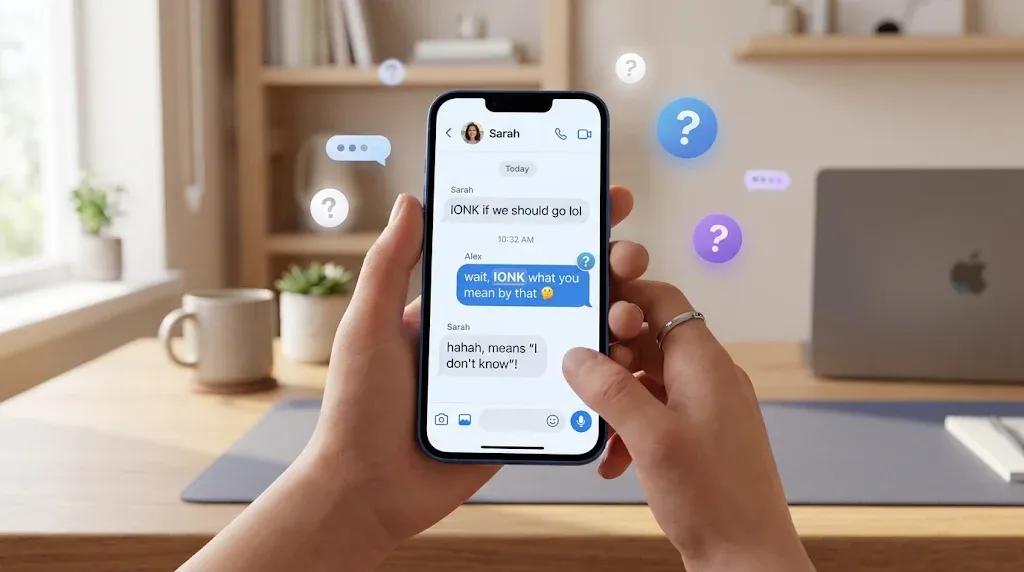
IONK generally means “I don’t know” in informal texting and online conversations. It is a less-standardized, phonetic-style expression associated with the way people casually pronounce “I don’t know.” It is similar in meaning to the more widely recognized abbreviation IDK.
For example, if your friend asks, “Do you know where Ahmed went?” and you respond with “IONK,” you’re communicating that you don’t have the answer.
You might encounter this expression in Snapchat messages, TikTok comments, Instagram DMs, WhatsApp chats, and other online conversations. However, because IONK is less established than IDK, its meaning should be interpreted through the surrounding sentence.
In this guide, we’ll explore what IONK means, how it is used, where it differs from similar expressions, and how to respond when someone sends it.
What Does IONK Mean in Text?
IONK generally means “I don’t know.” People use it in casual digital conversations when they are unsure about something, lack information, or cannot provide a definite answer.
It communicates the same basic idea as IDK, although its spelling is different.
For example:
- “IONK what happened yesterday.”
- “IONK where they’re going.”
- “IONK if she’s coming tonight.”
- “IONK bro, maybe ask him.”
Each example communicates uncertainty or a lack of knowledge.
Unlike traditional initialisms such as LOL and IDK, IONK is better understood as a phonetic-style spelling rather than a conventional abbreviation created from the first letters of several words.
In simple terms: When someone sends IONK in an ordinary conversation, they are most likely saying they don’t know.
IONK Meaning – Quick Overview
Here is a simple reference table to help you understand the expression.
| Detail | Explanation |
| Slang | IONK |
| Common meaning | I don’t know |
| Category | Informal internet slang |
| Communication style | Casual |
| Similar abbreviation | IDK |
| Usage | Text messages, comments, DMs |
| Tone | Depends on context |
| Formality | Informal |
| Alternative interpretation | Context-dependent |
The main thing to remember is that IONK is not as universally recognized as IDK. If the sentence does not make sense, asking the sender what they mean is the safest option.
What Does IONK Stand For?
IONK is commonly interpreted as a phonetic representation of “I don’t know.”
It is not a traditional acronym in which each letter represents a separate word. Instead, it is associated with the way the phrase can sound when spoken quickly in casual conversation.
The related spelling ION is particularly important here. Dictionary.com documents ION as a slang rendering of “I don’t,” especially associated with Black English. When followed by “know,” the expression becomes “ion know,” which conveys “I don’t know.”
IONK appears to extend this spoken-style spelling into a compact form.
Consider these examples:
| Expression | Meaning |
| ION | I don’t |
| ION know | I don’t know |
| IONK | I don’t know |
| IDK | I don’t know |
| IDC | I don’t care |
For example:
“IONK why he left early.”
In standard English, this means:
“I don’t know why he left early.”
Remember that IONK is an informal spelling, not a formally established English acronym.
Dictionary.com+1
How Did IONK Develop in Texting?
IONK fits into a broader pattern of internet communication in which people write words and phrases according to how they sound in everyday speech.
Instead of following traditional spelling rules, casual digital conversations often use shortened expressions, contractions, and phonetic spellings.
Some familiar examples include:
- Gonna – Going to.
- Wanna – Want to.
- Dunno – Don’t know.
- IDK – I don’t know.
- ION – I don’t.
The related spelling ION has a documented history in internet writing dating back to the 2000s. Dictionary.com explains its connection to colloquial Pronunciation, particularly in Black English.
However, the exact first use of IONK itself has not been established by the reliable linguistic references identified for this article. It would therefore be inaccurate to claim that a particular person, social media platform, or year invented it.
Dictionary.com+1
The important distinction is that the linguistic background of ION is documented, while the exact development of IONK remains less certain.
Why Do People Use IONK?
People use IONK to communicate uncertainty in a quick, relaxed way.
There are several reasons why someone might choose this expression instead of typing a complete sentence.
1. To express uncertainty
Someone may use IONK when they genuinely do not know the answer.
Example:
Friend: “What time does the event start?”
You: “IONK, nobody told me.”
2. To keep conversations casual
Some people prefer informal expressions because they sound more natural in everyday chats.
3. To save typing time
Short expressions can make quick messaging easier, particularly when someone is replying during a busy day.
4. To avoid guessing
If someone is uncertain, IONK provides a simple way to communicate that they don’t have reliable information.
5. To match online communication styles
Internet conversations often include abbreviations, phonetic spellings, emojis, and shortened sentences. And IONK fits into that informal communication style.
IONK Meaning on Snapchat, TikTok, and Instagram
IONK generally communicates “I don’t know” across social media platforms. Its meaning does not automatically change depending on which application someone uses.
However, the way people use it can differ slightly depending on the conversation.
IONK Meaning on Snapchat
On Snapchat, someone might use IONK when responding to a friend’s Snap, answering a question, or discussing plans through private messages.
Examples:
- “IONK where he went.”
- “IONK what you’re talking about.”
- “IONK yet lol.”
- “IONK, maybe ask Sarah.”
If someone sends you this expression, they are generally communicating that they do not know something.
IONK Meaning on TikTok
On TikTok, IONK may appear in comments, direct messages, or discussions about videos.
For example:
- “IONK why this video is trending.”
- “IONK but this is actually funny.”
- “IONK what happened in the last scene.”
The expression helps users communicate confusion or uncertainty without writing a longer response.
IONK Meaning on Instagram
On Instagram, IONK can appear in direct messages, Story replies, and comment sections.
Examples:
- “IONK where she bought that outfit.”
- “IONK if I’ll be free tomorrow.”
- “IONK, you should ask him.”
It generally serves the same purpose as IDK.
IONK Meaning on Facebook
IONK may also appear in Facebook Messenger conversations, group discussions, and comments.
For example:
Friend: “Do you know when the meeting starts?”
You: “IONK, check the group.”
The expression is informal and does not have a special Facebook-specific definition.
IONK Meaning in WhatsApp and Other Chats
In WhatsApp conversations, IONK is an informal way of communicating that someone doesn’t know something.
It may appear in private messages, family groups, conversations with friends, or online communities.
Here are some examples:
Example 1: Asking About Plans
Friend: “Are we going out tomorrow?”
You: “IONK yet, I’ll let you know.”
Example 2: Asking About Someone
Friend: “Where is Ali?”
You: “IONK, I haven’t seen him today.”
Example 3: Discussing School
Friend: “Did the teacher announce the results?”
You: “IONK, nobody told me.”
The expression may also appear in Discord chats, gaming conversations, Messenger, and iMessage.
Its intended meaning should always be interpreted through the complete message.
- Related To Another Article: https://visitespanly.com/spwm-meaning-in-text/
How to Use IONK in a Conversation
You can use IONK in informal conversations when you want to communicate that you are unsure about something.
Here are some natural situations where it may fit.
When you don’t know an answer:
“IONK what time the movie starts.”
When discussing plans:
“IONK if I’ll be available this weekend.”
When someone asks about another person:
“IONK where he lives.”
When talking about Something confusing:
“IONK what’s happening here lol.”
When you need more information:
“IONK yet, let me ask someone.”
The expression works best when communicating with people who understand this type of internet slang.
If someone might not recognize it, simply writing “I don’t know” is clearer.
Real Examples of IONK in Text Messages
The following examples demonstrate how IONK might appear in everyday conversations.
Example 1: Making Weekend Plans
Friend: “Are you coming to the party on Saturday?”
You: “IONK yet, I’ll tell you tomorrow.”
Meaning: You haven’t decided whether you will attend.
Example 2: Asking About a Friend
Friend: “Where did Ahmed go?”
You: “IONK, I haven’t seen him.”
Meaning: You don’t know Ahmed’s location.
Example 3: Discussing School Results
Friend: “Did you pass the examination?”
You: “IONK, the results aren’t announced.”
Meaning: You don’t have the information yet.
Example 4: Talking About a Movie
Friend: “Is that movie worth watching?”
You: “IONK, I haven’t watched it.”
Meaning: You cannot give an opinion because you haven’t seen the movie.
Example 5: A Funny Conversation
Friend: “Why is everyone laughing?”
You: “IONK lol.”
Meaning: You don’t know why everyone is laughing, and “lol” adds a playful tone.
Example 6: Asking About Someone’s Plans
Friend: “Is Sarah coming with us?”
You: “IONK, she hasn’t replied.”
Meaning: You don’t know whether Sarah will join.
Example 7: Discussing an Unexpected Situation
Friend: “What happened to your phone?”
You: “IONK, it suddenly stopped working.”
Meaning: You don’t know what caused the problem.
Does IONK Mean Something Different From a Girl or Guy?
No. IONK generally communicates the same thing regardless of who sends it.
A girl or guy can use it when answering questions, discussing plans, or expressing uncertainty.
However, the surrounding conversation may help you understand the sender’s tone.
When a girl sends IONK
For example:
You: “Do you want to go shopping tomorrow?”
Her: “IONK yet.”
She may simply be unsure about her plans.
When a guy sends IONK
For example:
You: “Are you watching the football match tonight?”
Him: “IONK bro.”
He may not have decided or may not know whether he will watch it.
Does IONK indicate romantic interest?
No. A single IONK message does not establish whether someone likes you, dislikes you, or is romantically interested.
Always consider the complete conversation instead of interpreting someone’s feelings from one abbreviation.
Is IONK Rude or Disrespectful?
No. IONK is not inherently rude, offensive, or disrespectful.
It is generally a casual expression used to communicate uncertainty.
However, the way someone sends it can influence how the message feels.
| Message | Possible tone |
| “IONK lol” | Playful |
| “IONK bro” | Friendly |
| “IONK yet” | Uncertain |
| “IONK 🤷” | Confused |
| “IONK, let me check” | Helpful |
| “IONK.” | Potentially blunt |
For example, replying with only IONK to an important question might seem dismissive if the other person expects a more thoughtful answer.
Adding a few extra words can make your response sound friendlier.
How to Respond When Someone Says IONK
If someone sends you IONK, your response depends on what you were discussing.
Here are some natural replies.
| Situation | Possible response |
| Casual conversation | “That’s okay lol.” |
| Asking for information | “No worries, I’ll check.” |
| Making plans | “Let me know when you decide.” |
| Funny conversation | “Haha, same here!” |
| You still need an answer | “Can you find out for me?” |
| Friendly discussion | “Alright bro, no problem.” |
| Someone seems confused | “It’s okay, I’ll explain.” |
You do not need to respond with another abbreviation. A simple sentence is perfectly acceptable.
IONK vs IDK vs ION vs IONO
These expressions may look similar, but their spelling, structure, and usage are not exactly the same.
Understanding their differences can help prevent misunderstandings.
| Slang | Meaning | Usage |
| IONK | I don’t know | Informal phonetic-style spelling |
| IDK | I don’t know | Established texting abbreviation |
| ION | I don’t | Phonetic slang spelling |
| IONO | I don’t know (in some informal usage) | Less-standardized variant |
| IDC | I don’t care | Expresses indifference |
| IMO | In my opinion | Introduces an opinion |
| Dunno | Don’t know | Casual English expression |
IONK vs IDK
Both expressions generally communicate “I don’t know.”
The main difference is their form.
IDK is a widely recognized initialism, while IONK is a less-standardized phonetic-style spelling.
For example:
- IDK what happened.
- IONK what happened.
Both communicate the same basic message.
IONK vs ION
ION generally represents “I don’t” in informal online writing.
For example:
“ION wanna go.”
This means:
“I don’t want to go.”
IONK, however, is used as a complete Expression meaning “I don’t know.”
There is another meaning worth knowing: uppercase ION can also stand for “in other news” when someone introduces a different topic.
For example:
“ION, did you watch the new movie?”
Here, ION introduces a change of subject rather than expressing uncertainty.
Dictionary.com+1
IONK vs IONO
IONK and IONO are sometimes associated with the same general expression, “I don’t know.”
However, neither spelling should be treated as a universally standardized abbreviation. Their interpretation depends on the community and sentence.
IONK vs IDC
These expressions have completely different meanings.
- IONK means “I don’t know.”
- IDC means “I don’t care.”
For example:
“IONK where he went” means you don’t know his location.
“IDC where he went” means his location does not matter to you.
This is an important distinction because uncertainty and indifference communicate different attitudes.
Does IONK Have Other Meanings?
IONK does not have a universally established alternative definition across texting communities.
Although “I don’t know” is the common interpretation in the slang references reviewed for this article, unusual abbreviations can sometimes have personal or context-specific meanings.
You may encounter several possibilities:
1. A personal abbreviation
Some people create their own shortcuts that only their friends understand.
2. A typing mistake
IONK could occasionally be an accidental combination of letters or a mistaken version of another expression.
3. A niche online expression
A particular gaming community, social group, or online discussion may use IONK differently.
4. A different interpretation of the sentence
Someone might use the same letters in a sentence where the intended meaning is not the usual slang interpretation.
For example, a person could write:
“IONK his full name, only his first name.”
They might intend to communicate that they only know his first name. However, this is a context-based interpretation, not evidence that “I only know” is an established general meaning of IONK.
If the intended meaning is unclear, asking the sender is better than assuming.
Explore More: https://blessnesty.com/
Is IONK Appropriate in Professional Communication?
IONK is generally suitable for informal conversations rather than professional communication.
Although it can work between friends, relatives, or people who understand internet slang, it may confuse readers in formal situations.
Avoid using it in:
- Professional emails.
- Job applications.
- Academic assignments.
- Business proposals.
- Official documents.
- Workplace reports.
- Formal client conversations.
Instead of writing:
“IONK when the report will be ready.”
You can write:
“I’m not sure when the report will be ready, but I’ll confirm the timing.”
Other professional alternatives include:
- “I’m not certain about that.”
- “I don’t have that information yet.”
- “Let me check and get back to you.”
- “I’ll confirm once I have the details.”
These expressions are clearer and more appropriate for professional communication.
People Also Ask
IONK generally means “I don’t know.” It is an informal, phonetic-style expression used in messages and online conversations when someone is unsure about something.
IONK is commonly interpreted as “I don’t know.” It is not a conventional initialism formed from the first letters of four separate words.
Yes, they generally communicate the same meaning. However, IDK is a more established and widely recognized texting abbreviation than IONK.
On Snapchat, IONK generally means “I don’t know.” People may use it when replying to Snaps, answering questions, or discussing plans with friends.
It generally means “I don’t know.” A girl may use it when she is uncertain about something or does not have an answer. It does not automatically indicate romantic interest or disinterest.
Conclusion
IONK generally means “I don’t know” in informal texting and online conversations. It is a less-standardized, phonetic-style expression associated with casual pronunciation rather than a conventional acronym.
You may encounter it in Snapchat messages, TikTok comments, Instagram DMs, WhatsApp chats, and other online discussions.
Although it is similar to IDK, the two expressions are not equally established. IDK is widely recognized, while IONK is a less-standardized spelling that may not be familiar to every reader.
The best way to understand IONK is to consider the surrounding conversation, the sender’s tone, and the context in which it appears.
Now, when someone sends you “IONK,” you’ll have a much better idea of what they are trying to communicate.








1 thought on “IONK Meaning in Text: What Does IONK Mean?”