Introduction
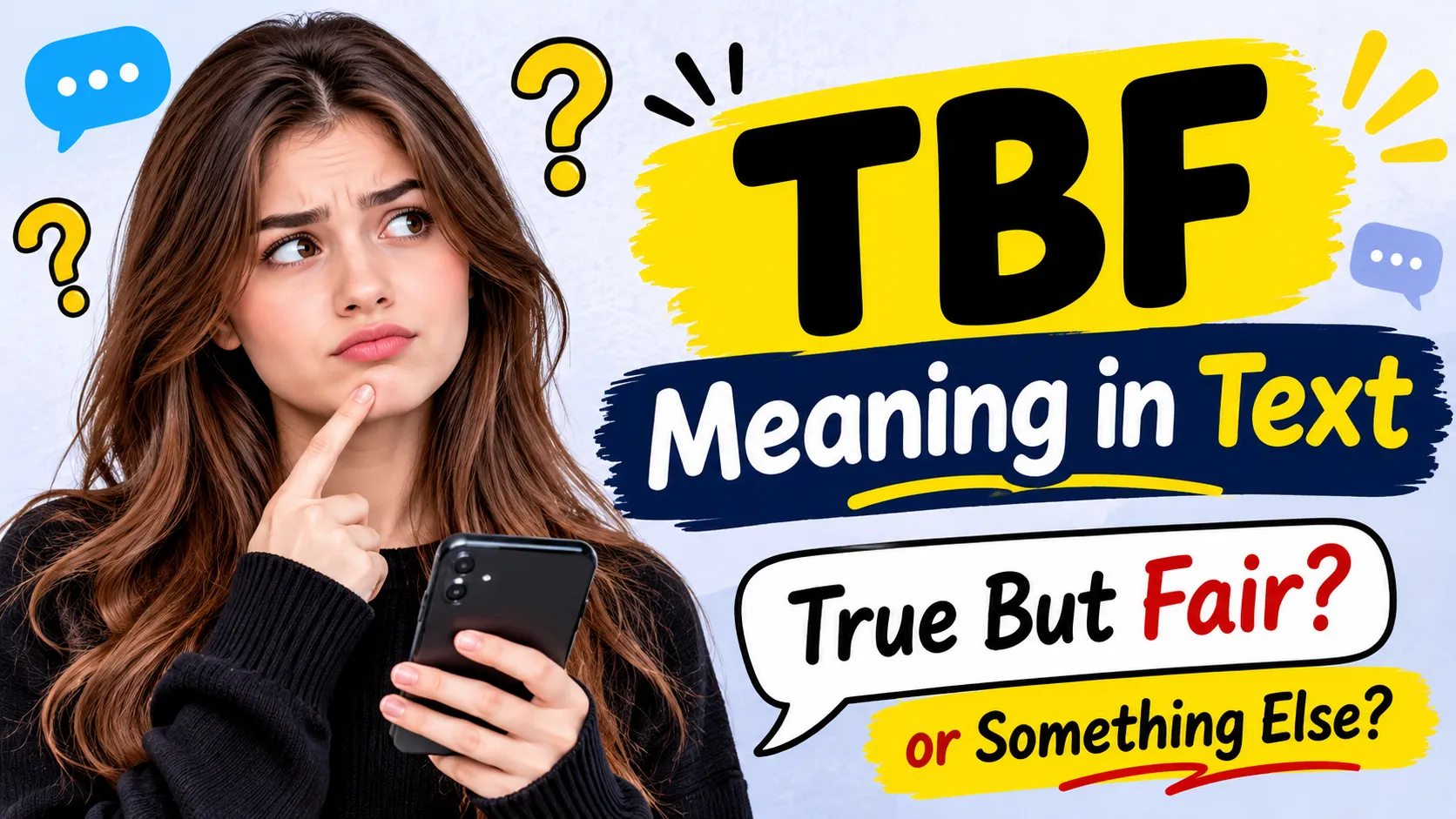
Have you ever received a message saying “TBF, I think you’re right” and wondered what those three letters mean? TBF is a common abbreviation in texting and online conversations, but its meaning can be confusing if you have never seen it before.
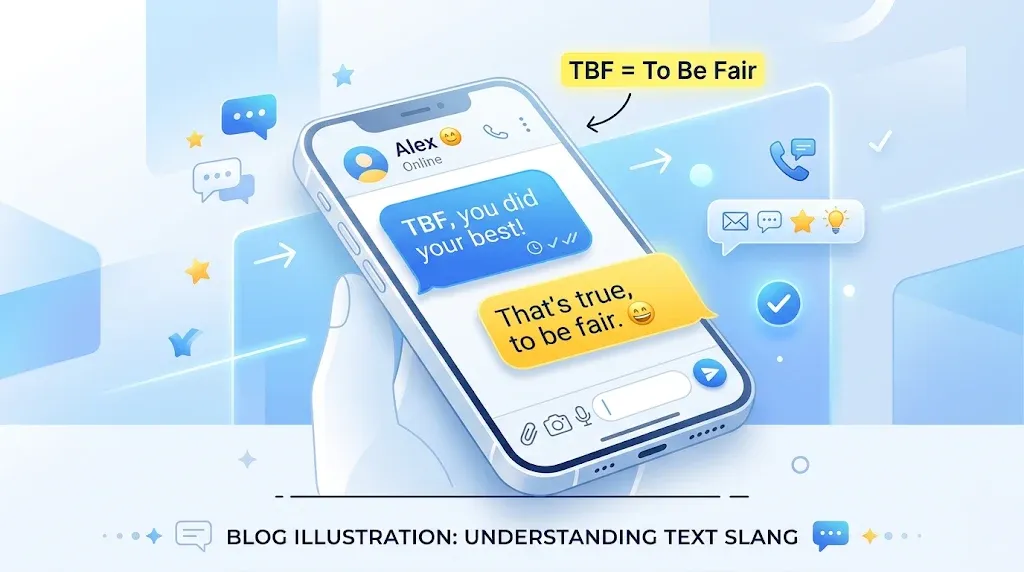
TBF means “To Be Fair.” People use it when they want to introduce a reasonable point, acknowledge another person’s perspective, defend someone, or add context before making a judgment.
For example, someone might write, “TBF, he did warn us earlier.” This means the sender believes the person deserves some consideration because he provided a warning.
You may encounter TBF in WhatsApp messages, Snapchat conversations, Instagram comments, TikTok discussions, and other online chats. Although the platform can influence the tone, the basic meaning usually stays the same.
In this guide, you’ll learn what TBF means in text, how to use it naturally, what it communicates in different situations, and how to respond when someone sends it to you.
What Does TBF Mean in Text?
TBF stands for “To Be Fair.” It is an informal written abbreviation used in text messages, social media conversations, and online discussions.
People typically use TBF to introduce a fair observation or acknowledge something that could change how a situation is understood.
For example:
- “TBF, she did her best.”
- “TBF, the restaurant was extremely busy.”
- “I didn’t enjoy the movie, but TBF, the acting was excellent.”
In each example, the sender is considering another side of the situation rather than making a one-sided judgment.
In simple words, TBF is another way of saying:
- To be fair…
- Looking at both sides…
- If we’re being reasonable…
- We should consider the full situation…
Quick answer: TBF means “To Be Fair” and is used to introduce a balanced opinion, acknowledge another perspective, or provide additional context.
TBF Meaning at a Glance
| Detail | Meaning |
| Abbreviation | TBF |
| Full form | To Be Fair |
| Category | Texting slang |
| Communication type | Informal |
| Main purpose | Introduce a fair point |
| Common locations | Texts, chats, comments, social media |
| Typical tone | Neutral, friendly, or sarcastic |
| Similar abbreviations | TBH, NGL, IMO, FWIW |
What Does TBF Mean in Texting and Chat?
In everyday texting, TBF helps people express a balanced opinion without writing the complete phrase “to be fair.”
It often appears when someone wants to explain another person’s behavior, recognize an overlooked detail, or disagree without sounding unnecessarily confrontational.
Consider this conversation:
Alex: “I don’t think Sarah did a good job organizing the event.”
Sam: “TBF, she had to arrange everything by herself.”
Sam is not necessarily saying that Sarah’s work was perfect. Instead, Sam is pointing out that Sarah deserves consideration because she handled the arrangements alone.
TBF can communicate several intentions:
- Acknowledgment: Recognizing that someone has a valid point.
- Fairness: Considering information that might have been overlooked.
- Defense: Explaining why someone’s behavior may be understandable.
- Clarification: Adding context to an earlier statement.
- Polite disagreement: Introducing another viewpoint without directly attacking someone’s opinion.
The surrounding sentence determines which intention is most likely.
Why Do People Use TBF?
People use TBF because conversations are not always straightforward. Sometimes a person wants to criticize something while still recognizing its positive aspects.
Here are five common reasons.
1. To Make a Fair Point
TBF can introduce an observation that makes a discussion more balanced.
Example:
“TBF, both teams played really well.”
The sender acknowledges that neither team deserves all the credit or criticism.
2. To Defend Someone
Someone might use TBF to explain another person’s actions when others are judging them.
Example:
“TBF, he didn’t know the meeting had been moved.”
This provides information that could make the person’s mistake more understandable.
3. To Soften Criticism
TBF can make negative feedback sound less one-sided.
Example:
“The delivery was late, but TBF, the weather was terrible.”
The sender still mentions the problem while acknowledging the circumstances.
4. To Give Someone Credit
People also use TBF when they want to recognize someone’s effort or achievement.
Example:
“TBF, she completed most of the project herself.”
This highlights a contribution that might otherwise be overlooked.
5. To Introduce a Different Perspective
During disagreements, TBF can help someone introduce another viewpoint.
Example:
“TBF, I understand why the teacher made that decision.”
The sender is asking others to consider the situation from a different angle.
How to Use TBF in a Sentence
Using TBF is straightforward. It can appear at the beginning, middle, or end of an informal sentence.
At the beginning:
“TBF, that was a pretty good performance.”
In the middle:
“He was late, but TBF, the traffic was terrible.”
At the end:
“She handled the situation quite well, TBF.”
The position does not change the basic meaning. What matters is that the abbreviation introduces or acknowledges a fair consideration.
12 Examples of TBF in Everyday Text Messages
Here are some natural examples showing how TBF works in Different Conversations.
- “TBF, you were right about that movie.”
- “TBF, he did apologize afterward.”
- “The food was expensive, but TBF, it tasted amazing.”
- “TBF, she has been working all week.”
- “I didn’t like the game, but TBF, the graphics were impressive.”
- “TBF, we should have planned everything earlier.”
- “He’s not that bad, TBF.”
- “TBF, they gave us enough time to prepare.”
- “She deserves some credit, TBF.”
- “TBF, that was the funniest thing I’ve seen today.”
- “I understand your point, but TBF, there is another side to this.”
- “TBF, the new update fixed several annoying problems.”
These examples show that TBF is not limited to disagreements. It can also introduce compliments, explanations, and positive observations.

TBF Meaning on Social Media
The meaning of TBF generally remains consistent across social platforms. What changes is the conversation surrounding it.
TBF Meaning on Snapchat
On Snapchat, TBF commonly appears in private messages, friend conversations, and story replies.
Example:
Friend: “I look terrible in that picture.”
You: “TBF, you took it after staying awake all night 😂”
The response is playful and explains rather than directly agreeing with the criticism.
TBF Meaning on Instagram
On Instagram, TBF can appear in direct messages, comment sections, and discussions about celebrities, photographs, or Trending Topics.
Example:
“Everyone is criticizing her outfit, but TBF, she looks confident in it.”
Here, the sender introduces a different perspective.
TBF Meaning on TikTok
TikTok users may write TBF when responding to opinions, viral videos, trends, and debates.
Example:
Comment 1: “This trend is getting boring.”
Comment 2: “TBF, some creators are still making interesting videos.”
The abbreviation introduces a counterpoint to the original comment.
TBF Meaning on WhatsApp
On WhatsApp, TBF is often used in personal conversations and group chats.
Example:
Friend 1: “Nobody helped with the assignment.”
Friend 2: “TBF, Ahmed completed the presentation.”
The second friend is reminding the group about someone’s contribution.
TBF on Facebook, Reddit, Discord, and X
TBF can also appear in Facebook discussions, Reddit threads, Discord communities, and X conversations.
For example:
“TBF, the original post left out some important information.”
In these spaces, it often introduces a counterargument, clarification, or additional context.
The important thing to remember is that TBF does not have a different official definition on every platform.
What Does TBF Mean From a Girl or Guy?
When a girl or guy sends you TBF, the abbreviation generally still means “To Be Fair.” The sender’s gender does not automatically give it a romantic or different slang meaning.
However, the surrounding conversation can help explain the intention.
When a Girl Says TBF
A girl might use TBF to acknowledge your opinion, defend someone, explain her perspective, or make a disagreement sound less confrontational.
Examples:
- “TBF, you did try your best.”
- “TBF, I understand why you were upset.”
- “You’re not completely wrong, TBF.”
- “TBF, he had a reasonable explanation.”
She may be agreeing with you, partially disagreeing, or simply adding context.
When a Guy Says TBF
A guy might use TBF to give someone credit, explain a situation, or introduce a different viewpoint.
Examples:
- “TBF, that was a good idea.”
- “TBF, he had a valid reason.”
- “I didn’t expect that, but TBF, you handled it well.”
Neither interpretation is automatically romantic. The full message and relationship between the people matter much more than the abbreviation alone.
Is TBF Rude, Friendly, or Sarcastic?
TBF is generally a neutral expression. It is not inherently rude, offensive, romantic, or sarcastic.
Its tone depends on the words that follow it, the relationship between the people, and the surrounding conversation.
Friendly TBF
“TBF, you’ve improved so much!”
This is a positive statement that recognizes someone’s progress.
Neutral TBF
“TBF, both options have advantages.”
This introduces a balanced observation without expressing a strong emotion.
Defensive TBF
“TBF, he wasn’t the only person responsible.”
This suggests that the sender wants others to consider additional circumstances.
Sarcastic TBF
“TBF, you only forgot the assignment three times!”
This uses exaggeration to create a sarcastic or humorous effect.
How Punctuation Can Change the Tone
Punctuation and sentence structure can also influence how TBF sounds.
| Message | Possible tone |
| “TBF, you’re right.” | Agreement |
| “TBF…” | Hesitation or introduction of a counterpoint |
| “TBF 😂” | Playful or humorous |
| “Well, TBF, that’s not what happened.” | Defensive or corrective |
| “TBF, I understand.” | Acknowledgment |
Punctuation alone cannot establish someone’s intention, so always consider the complete conversation.
How to Reply When Someone Says TBF
Your response depends on whether you agree with the other person’s point, want to add information, or have a different opinion.
Here are some natural ways to reply.
1. If You Agree
- “Yeah, that’s fair.”
- “True, I didn’t think about that.”
- “You have a point.”
- “Exactly!”
2. If You Want to Add More Context
- “That’s true, but there’s more to the story.”
- “Yeah, and another thing is…”
- “I agree. The situation was complicated.”
3. If You Disagree Politely
- “I understand, but I see it differently.”
- “That’s fair, although I still disagree.”
- “Maybe, but I think there’s another side.”
4. If Someone Is Defending You
- “I appreciate that!”
- “Thanks for understanding.”
- “Exactly, that’s what I was trying to explain.”
5. If You Want a Funny Reply
- “Finally, someone being reasonable 😂”
- “TBF, you’re not wrong!”
- “Okay, I’ll give you that one 😂”
You do not need a complicated response. Sometimes “True” or “That’s fair” is enough.
TBF vs TBH, NGL, IMO, IMHO, and FWIW
TBF is sometimes confused with other texting abbreviations because they are used in similar conversations. However, each expression has a different purpose.
| Abbreviation | Full form | Main purpose |
| TBF | To Be Fair | Introduces a balanced point |
| TBH | To Be Honest | Introduces an honest opinion |
| NGL | Not Gonna Lie | Expresses a candid statement |
| IMO | In My Opinion | Introduces a personal viewpoint |
| IMHO | In My Humble Opinion | Expresses an opinion modestly |
| FWIW | For What It’s Worth | Adds information considered useful |
TBF vs TBH
TBF means “To Be Fair,” whereas TBH means “To Be Honest.”
Examples:
- “TBF, he had a good reason for being late.”
- “TBH, I didn’t enjoy the party.”
TBF considers fairness and context. TBH introduces a candid opinion.
TBF vs NGL
NGL stands for “Not Gonna Lie.”
Examples:
- “TBF, the restaurant was quite good.”
- “NGL, I didn’t like the food.”
TBF introduces a fair consideration, while NGL signals a frank statement.
TBF vs IMO
IMO means “In My Opinion.”
Examples:
- “TBF, both players performed well.”
- “IMO, the second player was better,”
IMO emphasizes personal judgment, while TBF introduces a fair observation.
TBF vs FWIW
FWIW means “For What It’s Worth.”
Examples:
- “TBF, she did everything she could.”
- “FWIW, I had a similar experience.”
FWIW introduces information the sender thinks may be useful, while TBF emphasizes fairness.
When Should You Use or Avoid TBF?
TBF is useful in casual conversations, but it is not suitable for every communication setting.
When to Use TBF
You can comfortably use TBF when:
- Chatting with friends and family.
- Responding to social media comments.
- Discussing different opinions.
- Explaining someone’s actions.
- Giving another person credit.
- Making a friendly disagreement less confrontational.
- Participating in casual online discussions.
When to Avoid TBF
Avoid the abbreviation in situations where clear and professional language is expected, such as:
- Formal business emails.
- Academic assignments.
- Official reports.
- Legal documents.
- Professional presentations.
- Formal workplace communication.
Instead of writing “TBF,” use the complete expression “to be fair.”
For example:
Informal: “TBF, both ideas have potential.”
Professional: “To be fair, both proposals have considerable potential.”
Common Mistakes When Using TBF
Understanding TBF also means knowing what it does not mean.
Here are some common mistakes:
1. Confusing TBF with TBH
TBF means “To Be Fair,” not “To Be Honest.” These abbreviations communicate different things.
2. Assuming TBF Is Always Sarcastic
TBF can be friendly, neutral, defensive, or sarcastic depending on the conversation.
3. Thinking TBF Has a Romantic Meaning
It is not automatically a sign of romantic interest. It generally introduces a fair point or another perspective.
4. Using TBF in Every Sentence
Repeating the abbreviation unnecessarily can make your messages sound unnatural.
5. Ignoring the Surrounding Message
The sender’s complete statement is more important than the abbreviation alone. Read the entire message before interpreting the intention.
6. Assuming Every Platform Changes Its Meaning
TBF generally means “To Be Fair” across messaging and social media platforms. The context may change, but the standard definition remains the same.
- Related To Another Article: https://visitespanly.com/fml-meaning-slang/
People Also Ask
TBF stands for “To Be Fair.” People use it in messages to introduce a balanced opinion, acknowledge another perspective, or provide additional context.
In internet slang, TBF means “To Be Fair.” It is a casual abbreviation used in text messages, online chats, and social media discussions.
On Snapchat, TBF generally means “To Be Fair.” People use it in private messages and story replies when they want to explain something or acknowledge another person’s point.
On Instagram, TBF means “To Be Fair.” It commonly appears in comments and direct messages when someone wants to share a balanced opinion or offer another perspective.
On TikTok, TBF stands for “To Be Fair.” It often appears in comment discussions when someone wants to acknowledge another viewpoint or add context to an opinion.
Conclusion
Understanding TBF meaning in text is easy once you know that it stands for “To Be Fair.” People use this popular abbreviation to introduce balanced opinions, acknowledge different perspectives, defend someone, or add context to a conversation.
Whether you encounter TBF on Snapchat, Instagram, TikTok, WhatsApp, or in an ordinary text message, its basic meaning generally stays the same.
The next time someone sends you “TBF,” consider the surrounding conversation to understand exactly what they are trying to communicate. And if you want to use it yourself, remember one simple rule: use TBF when you want to make a fair point.
Explore More: https://blessnesty.com/










1 thought on “TBF Meaning in Text: Definition, Uses & Examples”