
Introduction: Choosing a School as a Strategic Family Decision
Choosing a school in Spain is not only an academic decision but also a life-shaping one that directly impacts a child’s emotional, social, and professional development.
For both local and international families relocating to Spain—especially to high-quality living cities like Valladolid—the school selection process becomes a key factor in integration and long-term educational success.
In this context, Sagrada Familia Jesuitinas School stands out as one of the most searched educational institutions for parents seeking a balance between:
High-quality education
Affordable tuition
Strong values-based learning
International outlook
Modern teaching methods
This guide provides a complete, objective, and updated (2026) overview of the school, covering its academic model, real costs, parental reviews, and comparisons with other institutions.
What is Sagrada Familia Jesuitinas School?
Sagrada Familia Jesuitinas is a state-subsidized (concertado) school, meaning it combines public funding with private management.
This hybrid model allows it to offer higher educational quality than many public schools while remaining significantly more affordable than private institutions.
Key Features
Type: State-subsidized (concertado) school
Location: Valladolid, Spain
Educational stages: Early Childhood, Primary, Secondary (ESO), and High School
Educational focus: Holistic education based on values
Key differentiator: International Baccalaureate (IB) programme
Importance for International Families
More and more expatriate families choose Spain for education due to:
Stability of the European education system
Lower costs compared to other European countries
High quality of life
Access to bilingual education
In this context, Jesuitinas provides a major advantage: continuous education from early years through high school without changing schools.
Educational Stages: Full Academic Pathway
One of the strongest aspects of the school is its complete academic structure.
Early Childhood Education (0–6 years)
This stage focuses on emotional and sensory development:
Early stimulation activities
Learning through play
Initial social interaction
Gradual introduction to English
The main goal is to build strong emotional foundations and positive learning habits.
Primary Education
During this stage, students consolidate core competencies:
Language and mathematics foundations
Logical thinking development
Teamwork skills
Introduction to digital tools
Autonomy and responsibility gradually increase.
Compulsory Secondary Education (ESO)
Academic demands increase significantly:
Critical thinking development
Greater personal responsibility
Interdisciplinary projects
Academic and career orientation
High School (National & International)
A key stage for university access:
University preparation
Academic specialization
Development of global competencies
Option to study the IB programme
Why Educational Continuity Matters
Avoiding school transitions brings several benefits:
Emotional stability
Better academic performance
Long-lasting friendships
Reduced adaptation stress
International Baccalaureate (IB): The Key Advantage
The IB programme is one of the most respected educational systems worldwide.
What is the IB?
It is an internationally recognized academic framework allowing access to universities in:
Europe
United States
United Kingdom
Canada
IB Advantages
Advanced critical thinking
Bilingual or multilingual education
More analytical evaluation methods
Greater international mobility
Comparison: Spanish Baccalaureate vs IB
Feature | Spanish Baccalaureate | International Baccalaureate
Focus | National | Global
Language | Spanish | Bilingual
Methodology | Traditional | Analytical
University access | Spain | International
Conclusion: IB provides a clear advantage for globally oriented students.
Teaching Methodology: Modern Learning Approach
The school follows modern European educational trends.
Core Teaching Methods
Project-Based Learning (PBL)
Students learn by solving real-world challenges.
Gamification
Game-like learning elements improve motivation.
Flipped Classroom
Theory is studied at home
Practice is done in class
Cooperative Learning
Teamwork is central to student development.
Digital Transformation
The school integrates modern educational technology:
Digital learning platforms
Classroom devices (laptops/tablets)
Multimedia resources
Digital skill development
Languages & International Focus
English proficiency is a key priority.
Language Offer
Advanced English
Bilingual programmes
Cambridge exam preparation
Benefits of International Focus
Better career opportunities
Easier access to foreign universities
Adaptation to global environments
Sagrada Familia Jesuitinas School Pricing
One of the most frequently asked questions is cost.
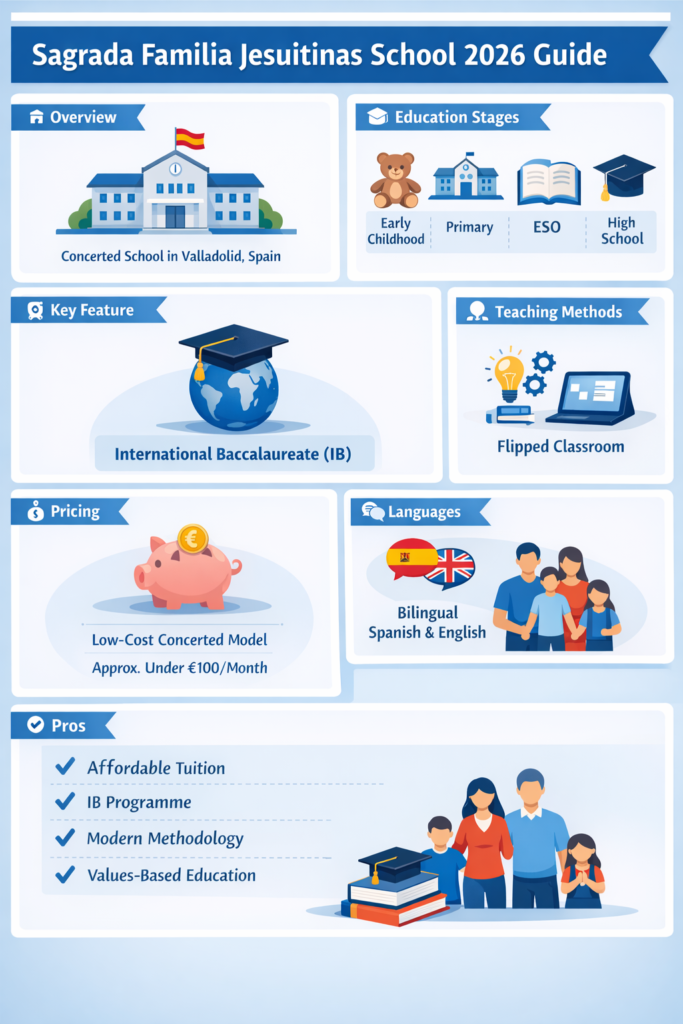
Estimated Costs
Early Childhood: subsidized or very low cost
Primary: mostly free with small contributions
ESO: low cost with extras
High School: highest cost stage
Average: often under €100/month in many stages
Additional Expenses
School meals
Extracurricular activities
School materials
Transportation
European Comparison
Country | Education Cost
Spain | Low
France | Medium
United Kingdom | High
Spain offers excellent value for money.
Parent & Student Reviews
Reviews help reflect the real experience.
Positive Feedback
Close and approachable teachers
Good school environment
Strong values-based education
Innovative teaching methods
Negative Feedback
Lack of cost transparency in some cases
Conflict management could improve
Variability in secondary education experience
Expert Recommendation
Visiting the school in person is strongly advised before making a decision.
Facilities & Services
The school offers well-developed infrastructure.
Facilities
Science laboratories
Sports facilities
Digital classrooms
Creative learning spaces
Services
School cafeteria
Transport services
Extracurricular activities
Comparison with Other Schools in Valladolid
Type | Price | Languages | IB
Jesuitinas | Medium-low | High | Yes
Public school | Free | Medium | No
Private school | High | High | Sometimes
Jesuitinas offers a strong overall balance.
Pros & Cons
Advantages
International Baccalaureate programme
Balanced cost-to-quality ratio
Modern teaching methods
Strong values-based education
Disadvantages
Additional hidden costs
Mixed reviews in some areas
Not fully free
Is Sagrada Familia Jesuitinas Worth It?
Yes, if you want:
International education
Affordable schooling
Well-rounded academic development
Not ideal if you prefer:
Fully public education
Zero-cost schooling
Simplified administrative structure
Final conclusion: a balanced and competitive educational option.
Spain as an Education Destination
Spain is increasingly attractive for international families.
Country Advantages
Mild climate
Moderate living costs
Open culture
Stable education system
Valladolid Advantages
Safe city
Strong academic environment
Lower cost than major cities like Madrid or Barcelona
FAQ – Frequently Asked Questions
- Is the school public or private?
It is a concerted school, meaning publicly funded but privately managed. - Does it offer International Baccalaureate?
Yes, it offers IB since 2023. - How much does it cost?
Usually under €100/month depending on services. - Is it good for international students?
Yes, due to bilingual education and global focus. - What is the English level?
High, with Cambridge preparation. - Is it one of the best schools in Valladolid?
Yes, especially for value-for-money quality.
Recommended Resources
Spanish Ministry of Education
OECD Education Reports
Eurydice European Education Systems
International Baccalaureate Organization
Expatica Spain Guide
Numbeo Cost of Living Database
Final Conclusion
Sagrada Familia Jesuitinas School is positioned as one of the most balanced educational options in Spain.
It stands out for:
Modern teaching model
Strong international focus
Affordable cost structure
Values-based education
IB programme availability
It is especially suitable for families seeking high-quality education without the high costs of fully private international schools.