Introduction: The Hidden Story Beneath a Masterpiece
Looking up comes naturally when people first see the Sagrada Familia in Barcelona. Towering spiers, glowing colored glass, yet detailed carvings pull every eye without effort. A rush of awe hits fast – like stepping into a dream built from stone and light. Yet down below, hidden from view, lies something quieter but more telling. Meaning here runs deep underfoot instead of high overhead.
Beneath the church, tucked out of sight, sits a place that changes everything – Museo de la Iglesia de la Sagrada Familia. Far from being just another room to walk through, it shapes how you see the whole site. Questions begin to make sense once you step inside. Wonder shifts, quietly, into deeper respect.
Outside the museum gates, the basilica strikes you first by how it looks. Its curves catch light differently each hour. Color spills across stone in ways hard to name. Size alone does not tell what lies beneath. Meaning hides behind quiet details. Innovation whispers where most just glance. Purpose stays out of view until something shifts. Stepping into the museum alters that. Everything tilts toward understanding. Now it clicks – the purpose in each curve, each column, each small feature. Instead of only looking impressive, the basilica starts to feel like walking through someone’s thoughts and feelings.
This 2026 guide covers everything you need to experience a place few know well. Expect to uncover:
- The historical background and evolution of the museum
- The visionary ideas behind its creation
- The most important exhibits and sections to explore
- Practical information about tickets, timing, and entry
- Insider tips to enhance your visit
- Lesser-known facts and fascinating curiosities
- Expert travel strategies to maximize your experience
- Fully seeing the Sagrada Familia changes how you hold its image later – understanding slips in where sight once ruled alone.
What is the Museo de la Sagrada Familia?
A Unique Underground Experience
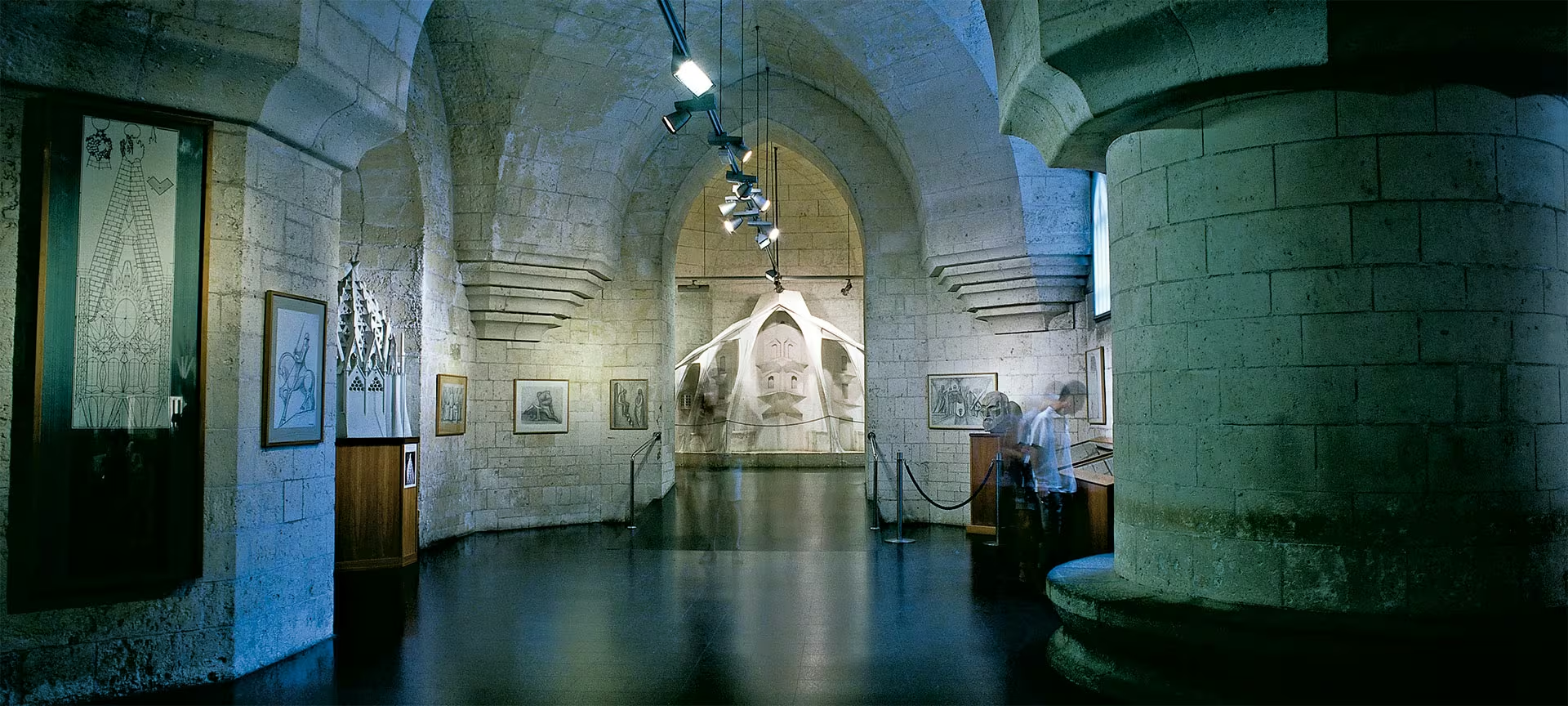
The Museo de la Iglesia de la Sagrada Familia is an underground exhibition area located within the basilica complex. Unlike traditional museums that focus on displaying static objects, this space serves as a dynamic and immersive environment designed to explain the complete story behind the construction of one of the most extraordinary buildings in the world.
The museum presents a comprehensive narrative that includes:
- The creative vision and philosophy behind the basilica
- The long and complex construction process that began in 1882
- The innovative architectural techniques used throughout its development
- The projected plans and future completion of the structure
What makes this museum especially distinctive is its interdisciplinary approach. It combines multiple fields into one cohesive experience:
- Artistic expression
- Engineering principles
- Religious symbolism
- Historical documentation
This fusion creates a multidimensional environment where visitors can engage with the basilica on several levels at once. It is not just informative—it is transformative.
Why the Museum is Essential (Not Optional)
Many visitors mistakenly skip the museum, assuming that the basilica itself is enough. This decision often leads to a superficial experience.
Without the Museum
- You witness beauty, but not significance
- You admire design, but miss intention
- You see structure, but not meaning
With the Museum
- You comprehend the genius behind the design
- You interpret hidden symbols and metaphors
- You develop an emotional connection to the project
A key principle in European travel is that context enhances experience. The more you understand, the more meaningful your visit becomes. The museum provides that context in a way that is accessible, engaging, and deeply enriching.
History of the Museo de la Sagrada Familia
The Vision of Gaudí
The museum exists to preserve and communicate the legacy of the architect behind the basilica. He was not simply a designer of buildings—he was a multidisciplinary creator whose work blended imagination, spirituality, and scientific observation.
His approach incorporated:
- Organic forms inspired by nature
- Complex geometrical systems
- Symbolic elements rooted in religious themes
- Structural solutions ahead of his era
Starting fresh every time, his process skipped standard plans altogether. With real models in hand, he twisted forms around, feeling how things fit together through trial. Because of this way of working – so different back then – he shaped solutions nobody had seen before. Outcomes like his hadn’t emerged in decades
Destruction During the Spanish Civil War
In 1936, during a period of conflict, much of the original material related to the basilica was lost. This included:
- Detailed sketches
- Architectural drawings
- Scale models
The destruction represented a significant setback, as these materials contained essential information about the project’s design and execution.
Reconstruction and Dedication
Following the conflict, architects and historians undertook the challenging task of reconstructing the lost materials. They relied on:
- Photographic evidence
- Surviving fragments
- Written descriptions
From careful work came new life for old designs, showing what the builder once imagined. Now inside the gallery sit real fragments alongside fresh builds, telling a story shaped by patience and resolve
Modern Evolution
The museum has evolved significantly over time. Today, it incorporates modern technology to enhance visitor engagement. Features include:
- Interactive digital displays
- Touchscreen interfaces
- Three-dimensional models
- Virtual simulations
This integration of technology allows visitors to explore complex concepts in a clear and intuitive way. The museum does not only look backward—it also presents forward-looking ideas about architecture and innovation.
What to See in the Museo de la Sagrada Familia
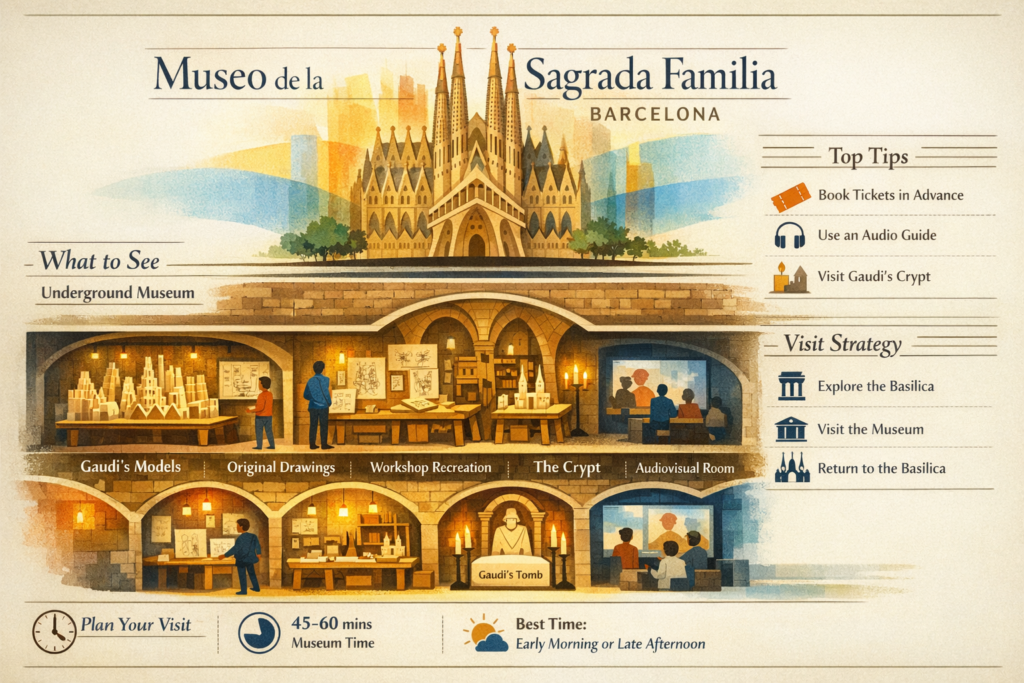
1. Original Plans and Drawings
This section showcases the initial concepts and early designs. Visitors can observe:
- Handcrafted sketches
- Experimental geometry studies
- Structural planning concepts
These materials reveal how abstract ideas were transformed into tangible forms.
2. Architectural Models (Maquetas)
One of the most captivating areas of the museum, these models demonstrate:
- The complete structure of the basilica
- Intricate curves and spatial relationships
- Future elements yet to be completed
Many of these models were reconstructed, adding historical depth to their visual appeal.
3. Gaudí’s Workshop Recreation
This exhibit recreates the working environment of the architect. It includes:
- Tools used during the design process
- Work surfaces and materials
- Techniques for model creation
This space offers insight into the creative process and working methods.
4. The Tomb of Antoni Gaudí
Located in the crypt, this area provides a quiet and reflective atmosphere. It serves as:
- A place of respect
- A moment of contemplation
- A tribute to a visionary life
5. Audiovisual Room
This section uses multimedia to explain complex ideas. Visitors can watch:
- Documentary films
- Time-lapse sequences of construction
- Visual explanations of techniques
6. Construction Evolution Displays
This area compares traditional and modern building methods. It highlights:
- Changes in construction techniques
- Advances in digital design
- Plans for future completion
Tickets, Entry & Practical Information
Is the Museum Included in the Ticket?
✔ Yes. The museum is included in all Sagrada Familia tickets.
Ticket Types Comparison
- Basic Entry: Museum access, no extras
- Guided Tour: Includes explanations from an expert
- Tower Access Ticket: Adds panoramic views
- Audio Guide Ticket: Self-paced exploration
Recommended Visit Duration
- Museum: 45–60 minutes
- Basilica + Museum: 2–3 hours total
Best Time to Visit
Early morning
Late afternoon
Avoid peak midday hours and weekends for a more relaxed experience.
How to Visit the Museum Like a Pro
Step-by-Step Strategy
- Begin with the basilica interior
- Observe without overanalyzing
- Visit the museum
- Learn the concepts
- Return to the basilica
This sequence significantly improves comprehension and appreciation.
Insider Tips for a Perfect Visit
Reserve tickets online in advance
Use an audio guide for deeper insight
Focus on architectural models
Hang around inside the underground chamber
Combine with other nearby attractions
European Context: How It Compares
Compared to larger institutions, this museum offers a focused and digestible experience. It is not overwhelming, making it ideal for travelers seeking depth without fatigue.
Pros and Cons of Visiting the Museum
Pros
Provides deeper understanding
Unique combination of disciplines
Interactive and engaging
Included in ticket
Suitable for all ages
Cons
Can become crowded
Limited seating areas
Requires time and attention
Not independent from basilica visit
Who Should Visit This Museum?
Ideal For
- Couples
- Architecture enthusiasts
- First-time visitors
- Students
Less Ideal For
- Visitors with limited time
- Those seeking quick experiences
Hidden Secrets & Curiosities
- Hanging models were used to study structural balance
- Future designs are displayed in detail
- Reconstructed models hold historical significance
- Advanced technologies assist in ongoing construction
Do’s and Don’ts
Do’s
Take your time
Read descriptions carefully
Use guides
Respect the environment
Don’ts
Avoid rushing
Do not skip the museum
Do not rely only on visuals
Do not ignore explanations
FAQs (SEO Optimized)
True, grasping the design and purpose behind the basilica starts here. Though often overlooked, its structure tells a story shaped by time. From the layout to the smallest detail, each piece holds weight. Without this view, much of what it represents fades. Seeing how parts connect reveals deeper layers long hidden.
Fresh off the entry ticket, you get straight into the basilica – no extra steps needed.
Around 45–60 minutes.
True, mainly because of hands-on displays along with images that show how things work.
Although guided tours offer more depth, audio versions hold their own too. Still, each helps in ways people might not expect at first glance.
Conclusion: A Must-Visit Hidden Gem in Barcelona
The Museum of the Church of the Holy Family is not simply an addition—it is the interpretive key that unlocks the full meaning of the basilica.
Without it, you observe a structure.
With it, you comprehend a masterpiece.
In a destination filled with attractions, this experience stands apart because it connects multiple dimensions of human creativity:
- Artistic imagination
- Scientific reasoning
- Spiritual depth
Visiting this museum ensures that your journey is not only memorable but also meaningful.