Introduction
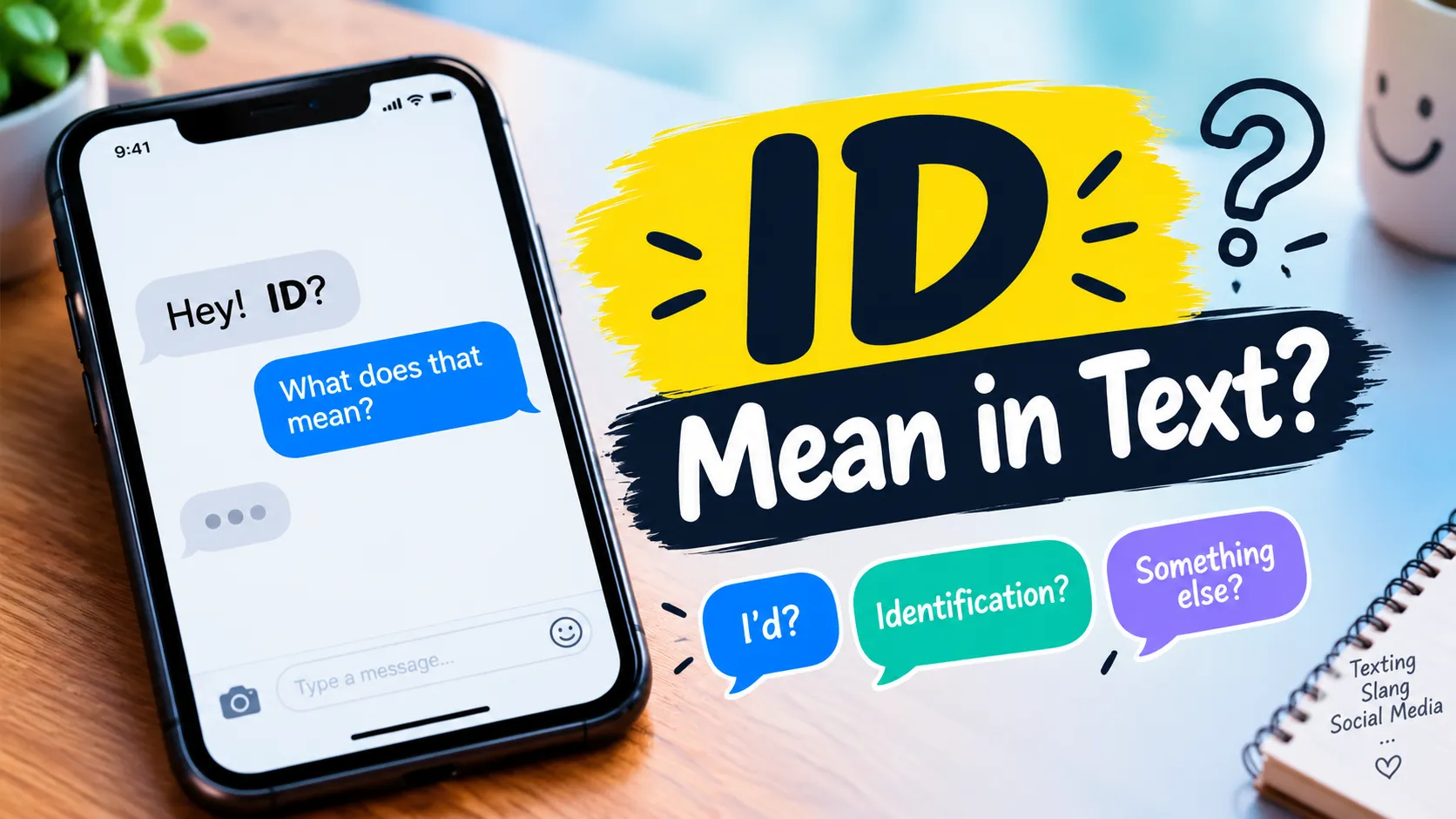
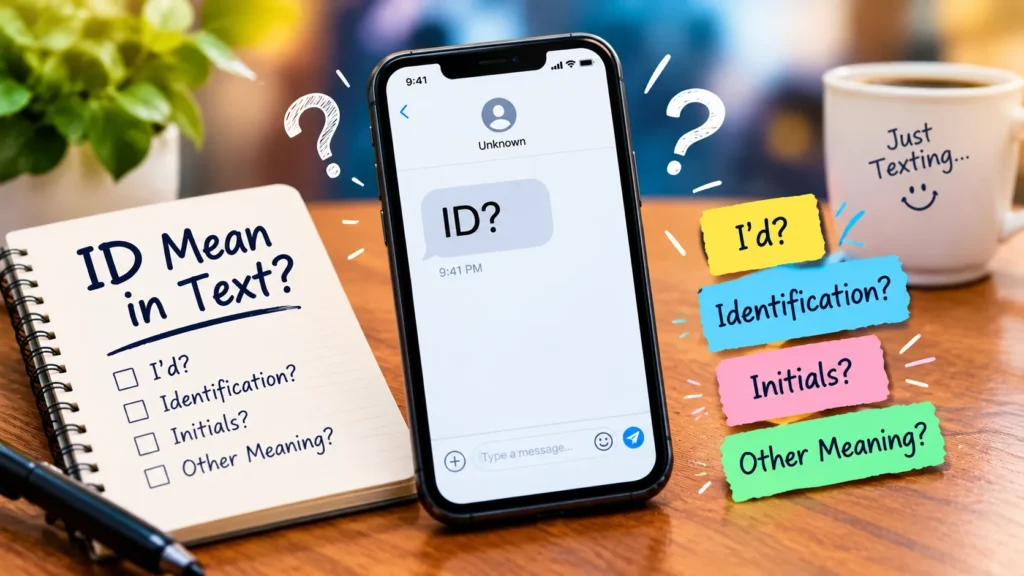
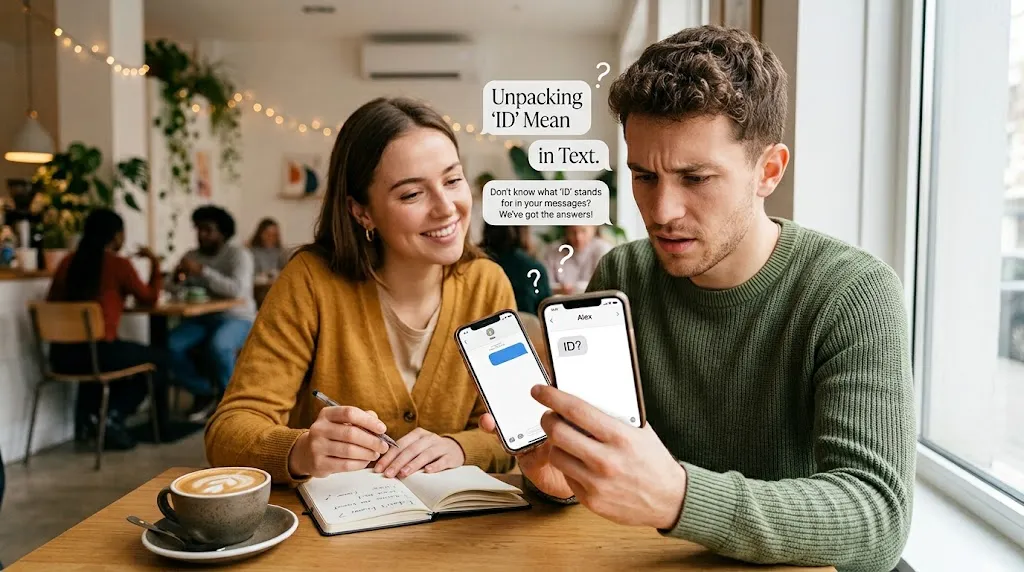
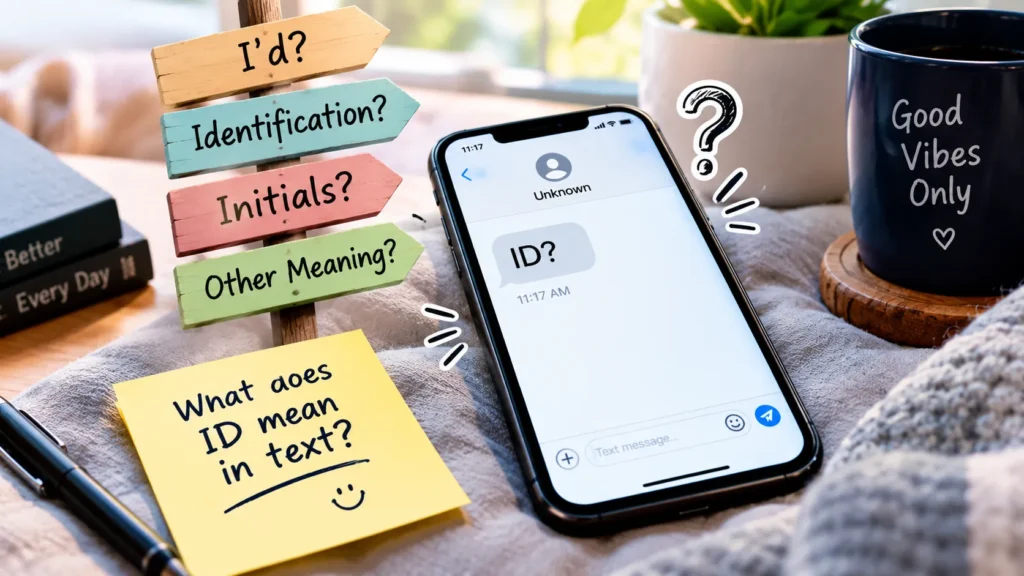
Have you ever received a text containing “ID” or “id” and wondered what the sender meant? The answer depends on the conversation. Sometimes it refers to identification, while in informal writing, lowercase “id” may be a way of typing “I’d” without an apostrophe.
Understanding the difference is important because ID, I’d, IDK, and IDC do not mean the same thing. For example, “Show me your ID” refers to identification, while “id love to come” probably means “I’d love to come.”
People also use ID when discussing social media accounts, gaming profiles, usernames, and identity verification. Therefore, the surrounding words usually provide the clearest clue.
In this guide, you will learn what ID Means in text messages, how to recognize its different meanings, how people use it online, and how to reply when someone sends it.
What Does ID Mean in Text?
ID usually means identification or identifier in texting and online communication. However, lowercase “id” can sometimes represent “I’d,” meaning “I would” or “I had,” when someone leaves out the apostrophe.
Here are some common examples:
- “Please bring your ID.” — Bring your identification.
- “What’s your user ID?” — What is your account identifier?
- “id love to see you.” — Probably “I’d love to see you.”
- “Can you ID this song?” — Can you identify this song?
- “IDK what happened.” — I don’t know what happened.
The key is to read the entire sentence instead of assuming that ID has only one meaning.
Quick Meaning Summary
| Term | Meaning | Example |
| ID | Identification or identifier | “Show me your ID.” |
| I’d | I would, or I had | “I’d love to go.” |
| id | Informal spelling of I’d in some messages | “I’d rather stay home.” |
| IDK | I don’t know | “IDK the answer.” |
| IDC | I don’t care | “IDC which movie we watch.” |
Remember that lowercase “id” is not a universally established texting abbreviation for “I’d.” The interpretation depends on the sentence.
What Is the Difference Between ID and I’d?
ID and I’d look similar, but their meanings and grammatical uses are different.
ID is commonly used as an abbreviation for identification or an identifier. I’d is a contraction of “I would” or “I had.”
Compare these examples:
- “I’d help you if I could.” — I would help you.
- “I’d already eaten.” — I had already eaten.
- “Please show your ID.” — Please show your identification.
- “Enter your account ID.” — Enter your account identifier.
In casual texting, someone might write “id help you” instead of “I’d help you.” Although the intended meaning may be clear, the missing apostrophe can confuse.
If replacing “id” with “I would” or “I had” makes sense, the sender may mean “I’d.”
Does ID Mean Identification in a Text Message?
Yes. ID often refers to an identification document or a unique identifier.
For example, someone might write:
- “Don’t forget your ID card.”
- “They asked me to upload my ID.”
- “My student ID isn’t working.”
- “You need a photo ID to enter.”
- “What’s your employee ID?”
Depending on the context, an ID might be a driver’s license, student card, employee badge, passport, or account identifier.
Privacy tip: If someone asks you to send an identification document online, verify their identity and the reason for the request before sharing sensitive information.
What Does ID Mean in Chat and Online Messages?
In online conversations, ID can refer to several things.
- Account ID: An identifier associated with an online account.
- User ID: Information used to distinguish one user from another.
- Player ID: An identifier used in an online game.
- Identification: A document used to verify someone’s identity.
- Identify: A verb, as in “Can you ID this person?”
- I’d: A possible interpretation of lowercase “id” in informal sentences.
For instance, “What’s your gaming ID?” probably refers to a player identifier. However, “id love to play” probably means “I’d love to play.”
The topic of the conversation helps you determine which meaning fits.
What Does ID Mean on Snapchat?
On Snapchat, ID may refer to an account identifier or information used to find someone’s profile. It can also refer to an identification document in a Verification-related conversation.
Example conversation:
Person A: “What’s your Snap ID?”
Person B: “Here’s my username. You can add me there.”
Here, the sender likely wants the information needed to find the other person’s account.
Another example:
Person A: “The app asked me to verify my identity.”
Person B: “Did it ask for an ID?”
In this case, ID means identification.
There is no single special Snapchat slang definition of ID that applies to every conversation.
What Does ID Mean on Instagram and TikTok?
On Instagram and TikTok, ID can refer to an account identifier, a profile, or identification requested during a verification process.
Examples include:
- “What’s your Instagram ID?” — The sender wants to find your account.
- “I forgot my user ID.” — The sender cannot remember their account identifier.
- “They asked me to submit an ID.” — The sender is talking about identification.
- “Can you ID this creator?” — The sender wants someone to identify the creator.
People sometimes use “ID” loosely when referring to social media accounts. The precise meaning depends on the platform and conversation.
What Does ID Mean When a Guy or Girl Texts It?
ID does not have a special meaning simply because a guy or girl sends it. The message’s wording and context matter more than the sender’s gender.
For example:
- A guy texts “What’s your ID?” He may want your social media account, gaming identifier, or identification.
- A girl texts “id love to come!” She probably means “I’d love to come!”
- Either person texts “IDK what to say.” It means “I don’t know what to say.”
Do not automatically assume that ID signals flirting, romance, anger, or disinterest. Look at the surrounding conversation before interpreting the sender’s intentions.
How to Tell What ID Means From Context
Use these clues to interpret the message correctly.
| Context | Likely meaning |
| Cards, documents, or identity verification | Identification |
| Websites, accounts, or games | Account Or User Identifier |
| “I’d like to,” “I’d rather,” or “I’d love to” | Possibly “I’d” |
| “IDK” | I don’t know |
| “ID this song” | Identify this song |
For example, “id like to meet you” probably means “I’d like to meet you” because that wording makes grammatical sense.
On the other hand, “Please enter your ID” refers to an identifier, not the contraction “I’d.”
If you still cannot determine the meaning, simply ask, “What do you mean by ID?”
Real Examples of ID in Text Conversations
These examples show how the same letters can communicate different things.
Example 1: Asking for identification
Alex: Don’t forget to bring your ID.
Sam: Thanks! I’ll bring it.
Meaning: Alex is referring to an identification document.
Example 2: Asking for a gaming ID
Mia: What’s your gaming ID?
Noah: I’ll send it to you.
Meaning: Mia wants Noah’s player identifier.
Example 3: Informal use of I’d
Ella: Would you come to the concert with me?
Jake: I’d love to!
Meaning: Jake probably means “I’d love to!”
Example 4: Using IDK
Ava: Do you know where the meeting is?
Leo: IDK, let me check.
Meaning: Leo says he doesn’t know.
Example 5: Identifying a song
Ryan: Can you ID this song?
Chris: Sure, send me the clip.
Meaning: Ryan wants Chris to identify the song.
How to Reply When Someone Sends ID
Your response should match what the other person means.
| Their message | Suggested reply |
| “Can you bring your ID?” | “Sure, I’ll bring it.” |
| “What’s your gaming ID?” | “I’ll send you my player ID.” |
| “id love to hang out!” | “Same! Let’s plan something.” |
| “Can you send me your ID?” | “Do you mean my account ID or my ID card?” |
| “What’s your Instagram ID?” | “Here’s my username.” |
If the request involves a sensitive document, clarify why it is needed before sending it.
Is ID Considered Texting Slang?
Not usually. ID is a widely recognized abbreviation for identification or identifier, rather than slang like LOL or BRB.
However, lowercase “id” sometimes appears in casual messages as an informal spelling of “I’d.” This is better understood as omitted punctuation than as a separate, universally accepted acronym.
For clear communication, write “I’d” when you mean “I would” or “I had,” and use “ID” when you mean identification or an identifier.
What Is the Difference Between ID, IDK, and IDC?
These terms look similar but have different meanings.
| Abbreviation | Full meaning | Example |
| ID | Identification or identifier | “What’s your ID?” |
| IDK | I don’t know | “IDK the answer.” |
| IDC | I don’t care | “IDC which movie we watch.” |
| I’d | I would, or I had | “I’d love to go.” |
IDK expresses uncertainty, while IDC expresses a lack of concern. ID generally refers to identification or an identifier, whereas I’d is a contraction.
When Should You Use ID in a Message?
Use ID when discussing identification, account identifiers, or gaming profiles.
Examples:
- “Please bring your ID.”
- “Enter your user ID.”
- “What’s your player ID?”
- “The website requires an ID for verification.”
If you mean “I would” or “I had,” use “I’d” instead. Although people sometimes omit apostrophes in casual conversations, correct punctuation makes your message easier to understand.
In professional emails, official instructions, and Important Messages, avoid ambiguous abbreviations whenever possible.
- Related To Another Article: https://visitespanly.com/ditto-meaning-in-text/
People Also Ask
ID usually means identification or an identifier. Lowercase “id” may sometimes mean “I’d” when the apostrophe is omitted. The surrounding sentence determines the intended meaning.
No, not usually. “I don’t” is normally written as those words, while IDK means “I don’t know.”
It has no special gender-based meaning. It could refer to identification, an account identifier, or an informal spelling of “I’d.”
The meaning depends on the message. He might be asking for an account ID or identification, or using lowercase “id” to mean “I’d.”
It may refer to an account identifier or identification. If someone asks for your Snapchat ID, they likely want information that helps them find your account.
Conclusion
The meaning of ID in text depends on the conversation. It most commonly refers to identification or an identifier, while lowercase “id” can sometimes stand for “I’d” in informal writing. IDK means “I don’t know,” and IDC means “I don’t care.”
When you see ID in a message, examine the surrounding words before deciding what the sender means. Understanding the context makes it easier to interpret the message and reply appropriately.