Catalonia Sagrada Familia:
Introduction
Standing near the Sagrada Familia in Barcelona changes how you see buildings. This place isn’t just bricks stacked high – instead, it tells stories through its shape and shadow. Because every curve holds meaning, because light slips through stained glass like whispered prayers. Yet beyond form, there’s feeling – an energy rising from years of vision poured into pillars and spires. Though silent, the walls speak of faith mixed with bold invention. So while many churches aim for grandeur, this one breathes differently – alive with purpose carved deep.
This famous church began as a dream of the famed designer Antoni Gaudí, his bold vision turning it into something unlike any building before. Still rising after more than a century and a half, work never stopping once since the first stone was laid.
Each year, crowds stream in from Europe, the U.S., and farther still, drawn by this grand creation. A few show up hoping to snap stunning images, some dig into hidden meanings, while plenty just want to stand before its sheer scale. Whatever brings them, most walk away quietly shaken.
This detailed guide covers every angle of Barcelona’s Sagrada Família – its history unfolds through bold architecture, hidden stories sit beneath the surface. Travel advice weaves into facts, timing shapes what you see. Discover how it became one of Europe’s standout sights without rushing toward conclusions. Details build slowly, context matters more than speed. A full picture forms by staying curious, not just following paths.
What Is the Sagrada Familia?
The Sagrada Familia is an immense Roman Catholic basilica and one of Spain’s most renowned landmarks.
Unlike conventional cathedrals, it merges religion, artistry, and natural inspiration into a single breathtaking composition. Its appearance is so imaginative that it often feels surreal—almost as if it belongs to another world.
Key Highlights
- Recognized as part of a UNESCO World Heritage Centre listing
- Designed in the distinctive Catalan Modernism style
- Still under construction today
- Among the most visited attractions in Europe
Beyond tourism, the basilica holds deep cultural importance—it stands as a powerful emblem of Catalan identity and pride.
Where Is the Sagrada Familia Located in Catalonia?
The basilica is situated in the Eixample district of Barcelona, an area celebrated for its wide avenues, geometric grid layout, and refined urban planning.
Why Location Matters
- Excellent connectivity via metro, buses, and taxis
- Close proximity to other works by Antoni Gaudí
- Ideal starting point for exploring the city
Besides places such as Paris or Rome, Barcelona brings together beach calm with bold art moves. That mix deepens what you feel walking near the Sagrada Familia
History of the Sagrada Familia
When Did Construction Start?
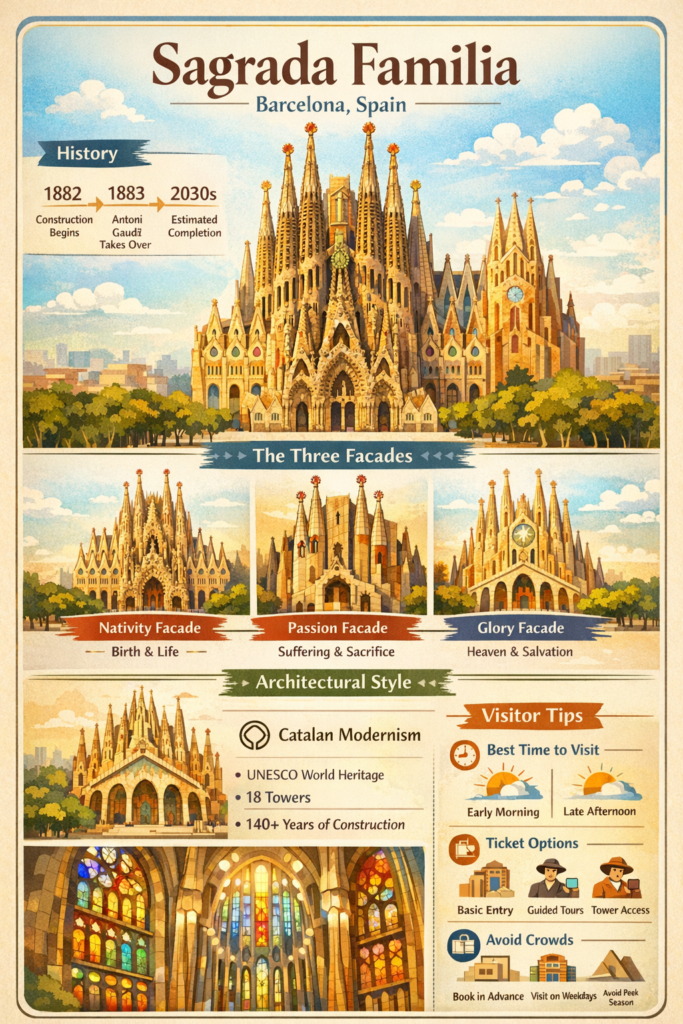
Work on the Sagrada Familia started back in 1882, led by architect Francisco de Paula del Villar.
That year things shifted fast once Gaudí took charge. His version broke every rule, turning plans into something never seen before.
Few knew how deep his commitment ran – forty years poured into stone and sky, the last stretch lived only for that rising spire.
Why Is It Still Not Finished?
A common question among visitors is why construction continues after such a long period.
Key reasons include:
- Funding relies heavily on donations and ticket revenue
- The design is exceptionally intricate and detailed
- Interruptions occurred during events like the Spanish Civil War
- Ongoing refinements and technological advancements
Estimated Completion
Work might finish sometime in the 2030s – official confirmation still missing. Still, that timeline hangs without a fixed point.
Weeks turn into years, then decades – people watch, curious, drawn in by how slowly it rises. What keeps eyes fixed is not speed but patience, a building growing like a tree, season after season. Its fame spreads quietly, built not with shouts but with time. One hundred years pass and still it climbs, becoming legend without trying.
Antoni Gaudí and His Vision
Who Was Gaudí?
Antoni Gaudí is widely regarded as one of history’s most innovative architects. His approach was radically different from traditional European styles.
He believed nature was the ultimate source of inspiration, and this philosophy is evident throughout the basilica.
Core Elements of His Vision
- Nature as a reflection of divine creation
- Geometry as a universal structural language
- Architecture as a storytelling medium
Gaudí famously described his ambition as creating a “Bible in stone.”
How Gaudí Was Different
Unlike Gothic cathedrals in countries such as Germany or France, his designs are:
- Organic
- Fluid
- Dynamic
This distinctive approach makes the Sagrada Familia truly unparalleled.
Architecture of the Sagrada Familia
Catalan Modernism Explained
The basilica is a prime example of Catalan Modernism—a style that blends:
- Gothic influences
- Natural forms
- Innovative engineering
Compared to Art Nouveau in cities like Brussels or Vienna, Catalan Modernism emphasizes symbolism and regional identity.
Unique Design Elements
The Sagrada Familia incorporates numerous extraordinary features:
- Columns resembling branching trees
- Vibrant stained-glass windows
- Flowing, curved architectural forms
Stepping inside feels like entering a luminous stone forest.
Mathematical Geometry in Design
Gaudí utilized advanced geometric principles, including:
- Helicoids
- Paraboloids
- Hyperboloids
These forms enhance both aesthetic beauty and structural integrity.
The Three Facades Explained
Nativity Facade Meaning
- Represents birth and life
- Highly ornate and detailed
- Inspired by nature
This is the only section completed during Gaudí’s lifetime.
Passion Facade Meaning
- Symbolizes suffering and sacrifice
- Minimalist and dramatic
- Defined by sharp lines
Its stark contrast highlights emotional intensity.
Glory Facade Meaning
- Represents heaven and spiritual transcendence
- Still under construction
- Will serve as the main entrance
Towers and Interior Design
The basilica will eventually feature 18 towers.
Tower Breakdown
- 12 towers dedicated to the Apostles
- 4 towers representing the Evangelists
- 1 tower honoring the Virgin Mary
- 1 central tower dedicated to Jesus Christ
Interior Experience
Inside, the atmosphere is breathtaking:
- Columns resemble towering trees
- Light shifts color throughout the day
- The ambiance feels peaceful and sacred
It is widely considered one of Europe’s most magnificent interiors.
Symbolism of the Sagrada Familia
Every element of the basilica carries meaning.
Examples of Symbolism
- Numbers reflect biblical messages
- Animals convey spiritual concepts
- Light symbolizes divine presence
This profound symbolism distinguishes it from most other cathedrals.
Why the Sagrada Familia Is Important to Catalonia
The Sagrada Familia is more than a monument—it is a cultural icon of Catalonia.
Cultural Significance
- Demonstrates artistic innovation
- Represents regional identity
- Attracts global tourism
Compared to landmarks like the Eiffel Tower, it carries deeper spiritual and symbolic meaning.
Visiting the Sagrada Familia
Best Time to Visit
For fewer crowds, plan your visit:
- Early morning (9:00–10:00 AM)
- Late afternoon (after 4:00 PM)
Ticket Options
- Basic Entry – access to the basilica
- Guided Tour – expert insights
- Tower Access – panoramic views
- Skip-the-Line – faster entry
Tips to Avoid Crowds
- Reserve tickets online in advance
- Visit on weekdays
- Avoid peak summer months
Hidden Facts Most Tourists Don’t Know
- Antoni Gaudí is buried inside the basilica
- Construction has exceeded 140 years
- Each facade narrates a different story
- It ranks among Europe’s most visited sites
Pros & Cons of Visiting the Sagrada Familia
Pros
- Extraordinary architecture
- Deep symbolic meaning
- Excellent photography opportunities
- Central location
Cons
- Can be overcrowded
- Ticket prices are relatively high
- Ongoing construction
Do’s and Don’ts for Visitors
Do’s
- Dress appropriately
- Book tickets in advance
- Consider a guided tour
Don’ts
- Avoid visiting without planning
- Skip peak hours when possible
- Don’t rush your experience
FAQs About Catalonia Sagrada Familia
Work continues, so completion likely lands in the 2030s.
Most folks find that one and a half to two hours does the job just fine.
Funny how such a spot even exists here. Truly stands apart from anything else around. Not many like it across the continent. Hard to believe it fits into Europe at all.
True – though only if you’ve got the right pass.
Nothing beats having someone show you around. A guide makes things easier to follow.
True – though little ones might run out of steam.
Many tickets cannot be returned for a refund.
Conclusion
Every stone at Sagrada Familia breathes time, shaped by hands across generations. More than just old walls, it grows like thought made visible. History flows into faith, while imagination pushes forward with quiet insistence. Where most buildings stop, this one keeps changing, step by unseen step.
This place stays with you, even if it is your first visit or one of many to Spain. A quiet moment inside makes the trip feel complete.
A well-considered approach turns what might have been mere observation into something fuller – walking through time among stones that still speak of grand human vision.