Introduction
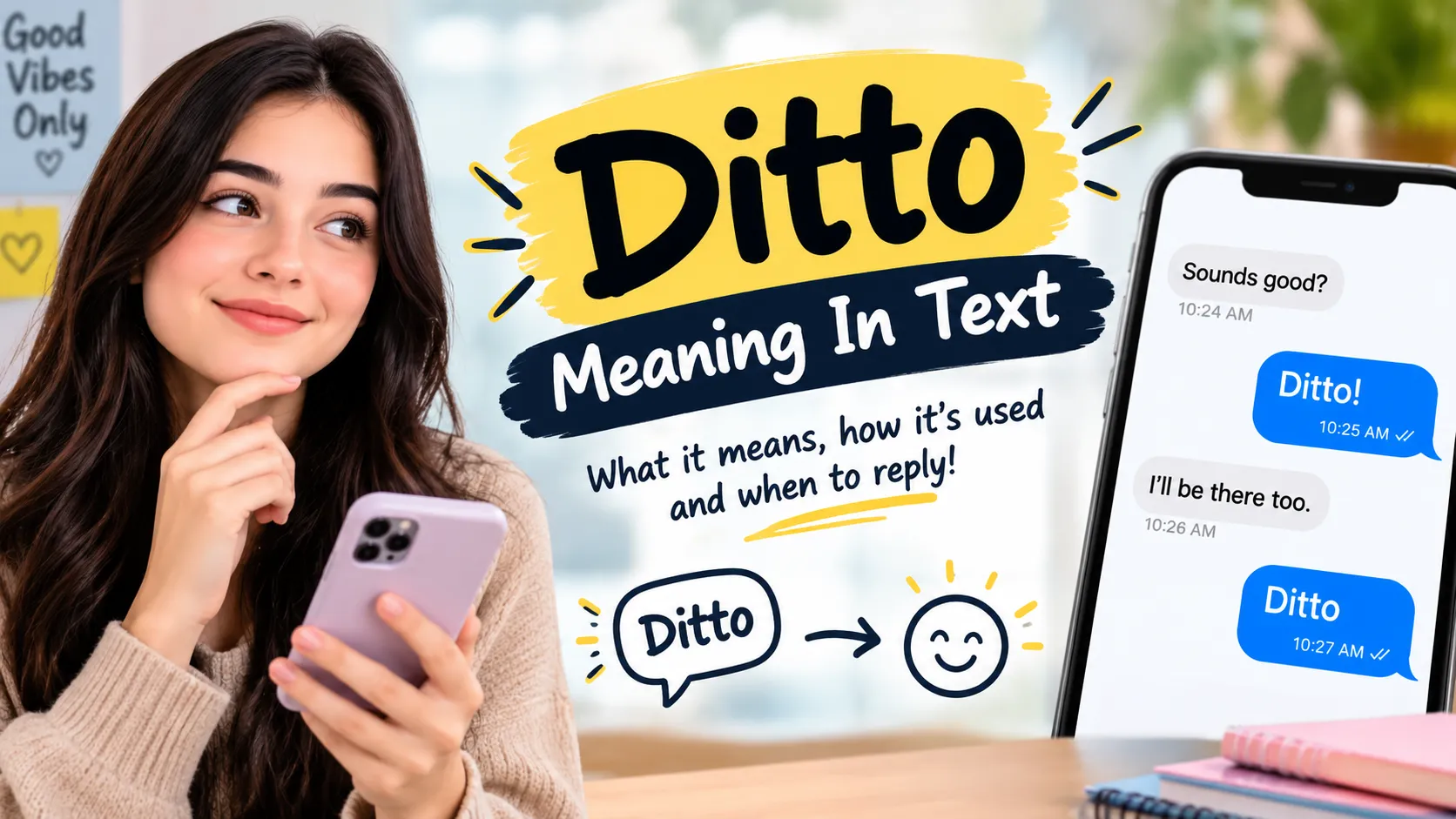
Have you ever received a text message that simply says “ditto” and wondered what the other person means? The Ditto Meaning In Text is usually “same here,” “me too,” or “I agree.” People use it to show that they share someone’s feelings, opinion, or experience without repeating the entire message.
For example, if your friend texts, “I’m exhausted today,” and you reply, “Ditto,” you mean that you are exhausted too. Depending on the conversation, ditto can sound friendly, playful, affectionate, or neutral.
Unlike popular texting abbreviations such as LOL and BRB, ditto is a complete English word, not an acronym. It has been used for centuries and remains useful in everyday conversations.
In this guide, you’ll discover what ditto means in text messages, how to interpret it when a guy or girl sends it, what it means in relationships, and how to respond naturally.
What Does Ditto Mean in Text?
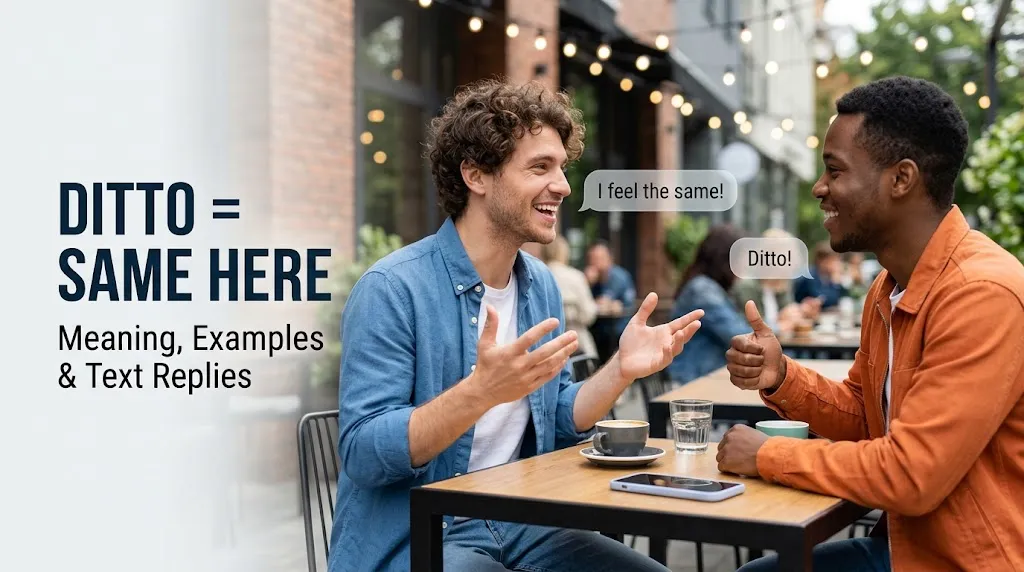
In texting, ditto means “the same applies to me,” “me too,” or “I agree.” It is a short way to express the same feeling, opinion, or experience as the person who spoke before you.
For example:
Friend: “I really need a vacation.”
You: “Ditto!”
Meaning: You need a vacation too.
The word usually refers to something already mentioned. Rather than repeating a complete sentence, you can simply say ditto to communicate that you feel the same way.
Quick Meaning Summary
| Term | Meaning |
| Ditto | The same thing applies |
| Ditto in texting | Same here, me too, or I agree |
| Ditto as slang | An informal one-word response |
| Ditto full form | No full form; it is a complete word |
| Ditto in relationships | A way to express shared feelings or agreement |
| Ditto with a heart emoji | May communicate affection or mutual feelings |
The exact interpretation depends on the message that came before it.
What Does Ditto Stand For? Is It an Acronym?
Ditto does not stand for a phrase. It is a regular English word, not an acronym or abbreviation.
Unlike LOL, which stands for “laughing out loud,” ditto has its own established meaning: the same as something already stated.
For example:
Person A: “I love rainy evenings.”
Person B: “Ditto.”
And Person B means that they love rainy evenings too.
People sometimes call ditto texting slang because it is used casually in messages and online conversations. However, the word itself is much older than modern texting.
How Is Ditto Used in Text Messages?
People use ditto to communicate agreement, shared experiences, preferences, and feelings. Here are common ways it appears in everyday chats.
1. To Show Agreement
Friend: “That was the best movie I’ve watched this year.”
You: “Ditto!”
You agree that the movie was excellent.
2. To Share the Same Feeling
Friend: “I’m exhausted after work.”
You: “Ditto.”
You are saying that you feel exhausted too.
3. To Express the Same Preference
Friend: “I’d rather stay home tonight.”
You: “Ditto.”
You also prefer staying home.
4. To Show Excitement
Friend: “I can’t wait for our weekend trip!”
You: “Ditto”
You are equally excited about the trip.
5. To Return a Positive Sentiment
Friend: “It was lovely spending time with you.”
You: “Ditto!”
You mean that you enjoyed spending time with your friend as well.
In each example, the previous message makes the meaning clear.
What Does Ditto Mean From a Guy?
When a guy texts “ditto,” he generally means “same here,” “me too,” or “I agree.” What he intends depends on your conversation and the message he is responding to.
If you tell him you miss him:
You: “I miss hanging out with you.”
Him: “Ditto”
He is saying that he misses spending time with you too.
If you talk about a shared interest:
You: “I could eat pizza every day.”
Him: “Ditto”
He shares your preference for pizza.
If you express affection:
You: “I really like talking to you.”
Him: “Ditto”
He is returning the sentiment and saying that he enjoys talking to you too.
Does Ditto Mean He Likes You?
Not necessarily. A guy may use ditto to express romantic interest, friendship, or simple agreement. The word alone cannot tell you whether he has romantic feelings.
Consider the wider conversation, how he normally Communicates, and whether his actions show consistent interest.
What Does Ditto Mean From a Girl?
When a girl texts “ditto,” she usually means that she shares your feeling, agrees with your opinion, or has the same preference.
For example:
You: “You always make me laugh.”
Her: “Ditto 😂”
Depending on the context, she may mean that you make her laugh too or that she shares the playful sentiment.
Another example:
You: “I had a great time with you today.”
Her: “Ditto ❤️”
She is saying that she enjoyed spending time with you as well.
If a girl sends ditto after an affectionate message, it can be a positive sign that the feeling is mutual. However, it does not automatically prove romantic interest. Context and the relationship between you matter.
What Does Ditto Mean in a Relationship?
In a relationship, ditto can be a simple way for partners to express mutual feelings without repeating an entire sentence. It may communicate affection, happiness, excitement, or agreement.
Consider these examples.
Example 1: Missing each other
You: “I wish you were here with me.”
Partner: “Ditto ❤️”
Meaning: Your partner wishes you were together too.
Example 2: Sharing happiness
You: “I’m so happy we met.”
Partner: “Ditto 🥰”
Meaning: Your partner shares that happiness.
Example 3: Making plans
You: “Let’s spend Sunday together.”
Partner: “Ditto!”
Meaning: Your partner agrees with the idea or wants the same thing.
Example 4: Sharing a difficult experience
You: “This week has been stressful.”
Partner: “Ditto.”
Meaning: Your partner has experienced similar stress.
A short reply is not automatically a sign of disinterest. Some people naturally communicate in fewer words. If you need more reassurance or a fuller response, it is reasonable to communicate that preference.
What Does Ditto Mean After “I Love You”?
When someone responds with “ditto” after you say “I love you,” they may mean “I love you too.”
For example:
You: “I love you ❤️”
Partner: “Ditto ❤️”
In this situation, the reply can be affectionate or playful. However, ditto is less explicit than directly saying “I love you too,” so the intended meaning depends on your relationship and usual communication style.
If you want to respond playfully, try one of these:
- “Aww, say it properly! ❤️”
- “Love you too, huh? 🥰”
- “I’ll take that as a yes 😂”
- “You’re cute when you keep it short.”
- “Ditto back at you ❤️”
If you are unsure whether the person is being affectionate or avoiding the question, ask them directly rather than assuming what they mean.

What Does Ditto Mean on Snapchat and Instagram?
The meaning of ditto generally stays the same across social media platforms. It usually means “same here,” “me too,” or “I agree.” The surrounding conversation determines its tone.
Ditto on Snapchat
On Snapchat, ditto may appear in private chats or replies to Snaps when someone shares the same feeling or opinion.
Example:
You: “I need a vacation so badly 😭”
Friend: “Ditto.”
Your friend wants a vacation too.
Ditto on Instagram
On Instagram, people may use ditto in direct messages, comments, or story replies.
Example:
You: “This sunset is absolutely beautiful.”
Friend: “Ditto 😍”
Your friend agrees that the sunset is beautiful.
Ditto on WhatsApp
In WhatsApp conversations, ditto can be a quick response to a friend’s message or a statement in a group chat.
Example:
Friend: “I need coffee before I do anything today.”
You: “Ditto 😂”
You also need coffee.
Ditto on TikTok and Other Platforms
The same meaning can apply in TikTok comments, Discord chats, Facebook conversations, and replies on X. Someone may use ditto to agree with an opinion or show that a relatable experience applies to them too.
The platform does not normally give the word a special meaning. Context, Punctuation, emojis, and the relationship between the people chatting provide the best clues.
How to Reply When Someone Says Ditto
The best response depends on what the other person is agreeing with. You can keep the conversation short or add more detail to make your response warmer.
Simple Replies to Ditto
Use these in everyday conversations:
- “Same!”
- “Exactly!”
- “I know, right?”
- “Glad we agree.”
- “Haha, true.”
- “Right?”
Funny Replies to Ditto
If you are chatting with a friend, try:
- “Great minds think alike 😂”
- “Copycat!”
- “We share one brain cell.”
- “Ditto squared!”
- “Finally, someone gets it 😂”
Friendly Replies to Ditto
These work when a friend shares your opinion or experience:
- “Glad I’m not the only one!”
- “We’re definitely on the same page.”
- “At least we agree on that.”
- “Haha, I knew you would understand.”
- “Same energy!”
Flirty Replies to Ditto
If the conversation is already romantic or playful, you could say:
- “Aww, we’re alike ❤️”
- “Then we should do something about it 😉”
- “That makes two of us 🥰”
- “I had a feeling you’d say that.”
- “Same feelings, huh? ❤️”
Choose a flirty response only when it fits your relationship with the other person.
Supportive Replies to Ditto
Sometimes a one-word response is a chance to connect more Meaningfully.
You: “I’ve been having a difficult week.”
Friend: “Ditto.”
You: “I’m sorry you’re dealing with that too. Want to talk about it?”
This response acknowledges their experience and encourages a more supportive conversation.
Ditto vs. Same vs. Me Too vs. Likewise
These expressions have similar meanings, but they can sound slightly different depending on the situation.
| Expression | Meaning | Example |
| Ditto | The same thing applies to me | “I’m tired.” — “Ditto.” |
| Same | I relate to that | “I need coffee.” — “Same.” |
| Me too | I share that feeling or preference | “I love music.” — “Me too.” |
| Likewise | The same applies to me, often in return | “Nice to meet you.” — “Likewise.” |
| I agree | I share your opinion | “This is the best option.” — “I agree.” |
Which expression should you use?
Use ditto when you want a short, neutral, or slightly playful reply. Same is common in casual online conversations; me too is straightforward, and likewise often works when returning a sentiment or using a more polished tone.
Does Ditto Sound Rude, Cold, or Sarcastic?
Ditto is not inherently rude. It is often a neutral or friendly way to agree. However, because it is brief, it can sometimes sound distant or sarcastic.
The meaning depends on the situation, the preceding message, punctuation, emojis, and your relationship with the sender.
Friendly example
Friend: “I’m so excited about our trip!”
You: “Ditto!! 😍”
The enthusiastic punctuation and emoji suggest excitement.
Neutral example
Friend: “I’m tired.”
You: “Ditto.”
This is a straightforward acknowledgment of a shared feeling.
Potentially dismissive example
You: “I spent hours preparing this presentation, and nobody helped me.”
Friend: “Ditto.”
Depending on the circumstances, the reply might mean that the friend has experienced the same problem. It could also feel dismissive if you were looking for empathy.
Potentially sarcastic example
Person A: “You never listen to me.”
Person B: “Ditto.”
The response may be sarcastic because it turns the complaint back on the other person.
Do not assume someone’s intentions from one word alone. If the conversation matters, asking what they meant is often the clearest solution.
What Is the Origin of the Word Ditto?
The word ditto has roots in Italian and is related to detto, meaning “said,” which ultimately comes from the Latin dictus, also meaning “said.” English has used the word since the early seventeenth century.
Historically, ditto was used to indicate something already mentioned, especially in written lists and records. It allowed people to avoid writing the same information repeatedly.
The word also developed a use as a ditto mark, represented by quotation-like marks in some lists, to indicate that the entry was the same as the one above it.
Over time, the word became common in everyday conversation as a quick way to agree with someone or indicate that the same statement applied.
This history explains why ditto works naturally in texting: instead of repeating an entire sentence, you refer back to what has already been said.
When Should You Use Ditto in a Conversation?
Ditto is useful when the previous message clearly expresses something you also feel, believe, or experience.
Good situations for using ditto:
- Agreeing with a friend’s opinion.
- Sharing the same mood or experience.
- Responding to a casual compliment or sentiment.
- Participating in a lighthearted group chat.
- Avoiding repetition in a conversation.
When a fuller response is better:
- When someone shares serious personal news.
- When the other person needs emotional reassurance.
- When you need to explain a decision or provide specific feedback.
- When a short response could be misunderstood.
- When communicating formally at work.
For example, if a colleague says, “I agree with the proposed deadline,” you might use “ditto” in an informal team chat. In a formal email, “I agree with the proposed deadline as well” is clearer and more professional.
The goal is not to avoid short replies. Choose a response that suits the situation.
People Also Ask
Ditto means “same here,” “me too,” or “I agree.” It shows that the same statement, feeling, or experience applies to you.
Ditto has no standard full form because it is a complete word, not an acronym. It means the same as something already stated.
Ditto is an established English word commonly used informally in texting. Although it can function like slang in casual messages, it is not a newly invented texting abbreviation.
It can mean “I love you too” when someone uses it in response to “I love you.” The intended meaning depends on the relationship and context.
It usually means your crush shares the feeling, preference, or opinion you just expressed. It may be affectionate, but it does not automatically prove romantic interest.
Conclusion
The ditto meaning in text is simple: it usually means “same here,” “me too,” or “I agree.” It allows people to express a shared opinion, feeling, or experience without repeating an entire sentence.
Whether you see ditto in a conversation with a friend, a romantic partner, or someone on social media, look at the preceding message to understand its meaning. A single word can communicate agreement, affection, humor, or a simple Acknowledgment.
When in doubt, consider the context or ask the person directly. Understanding the conversation is the easiest way to understand what they really mean.