Introduction
Sagrada Familia is a cool building in Europe that gives people a feeling of amazement when they see it. Sagrada Familia is a church designed by a creative man named Antoni Gaudí, who came from a place called Catalonia. This church is very big. A lot of people know about it.
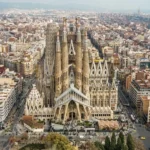
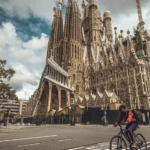
When people see the Sagrada Familia from outside, they are totally surprised by the front of the church and the carvings on it and how big it is in a city called Barcelona in Europe. But what is really cool about the Sagrada Failia is what is inside the church.
The inside of the Sagrada Familia is not like other churches where people go to pray. It is a special experience. People think it is going to be like the other churches in Europe. But when people go inside the church and see a big open space with a lot of light and columns that look like trees, they feel as though they are in a special place and as though they are in nature. The Sagrada Familia is a special church.
The sun comes through the colored windows.
More tips
Gaudí had a very exciting idea! He wanted people who came to the church to feel like they were walking into a forest! He wanted the church to feel like it was a part of the natural world, connected to something.
The inside of the basilica has four big ideas:
- Nature
- Mathematics
- Spirituality
- Building Techniques
- These four ideas combined create a very special space, one that is unlike any other church in the world.
Today, many travelers come to the church each year to look at the inside. For people, the inside of the basilica is even more amazing than the outside.
In the following guide, we will look at the inside of the Sagrada Familia, learn about:
- What the inside of the basilica looks like
- The story behind Gaudí’s inside
- The important things to look at inside
- How to take the best photos
- Interesting history
- Why many travelers come to the church each year
- Whether you are planning a
How the Sagrada Familia Looks Inside
The Sagrada Familia has a Latin cross shape inside, like many old churches in Europe.
Gaudi didn’t just copy buildings; he thought about design in a completely new way.
The inside of the Sagrada Familia is light, open, natural. Not dark. Not closed in like so many Gothic churches.
- There are no walls, no dark corridors.
- The inside is light, airy.
- When you walk into the hall, you see how high the ceiling is.
- The columns go up like trees.
- The vaults on the ceiling go out like branches.
- So you have a kind of space that is huge and peaceful at the same time.
- The Sagrada Familia has a sense of vertical height.
- The columns go up like trees, the geometric shapes on the ceiling go out like branches.
- So you have a kind of space that is huge and peaceful at the same time.
- The inside of the Sagrada Familia is like a light, airy space.
The Interior Layout
The basilica contains several major architectural sections that work together to create the interior structure.
Main Interior Components
The church has a few cool things:
Five aisles
- A huge area in the middle called the nave
- A huge area crossing the church called the transept
- A semicircle called the apse, which is like a huge half-circle
- There is a crypt beneath the church
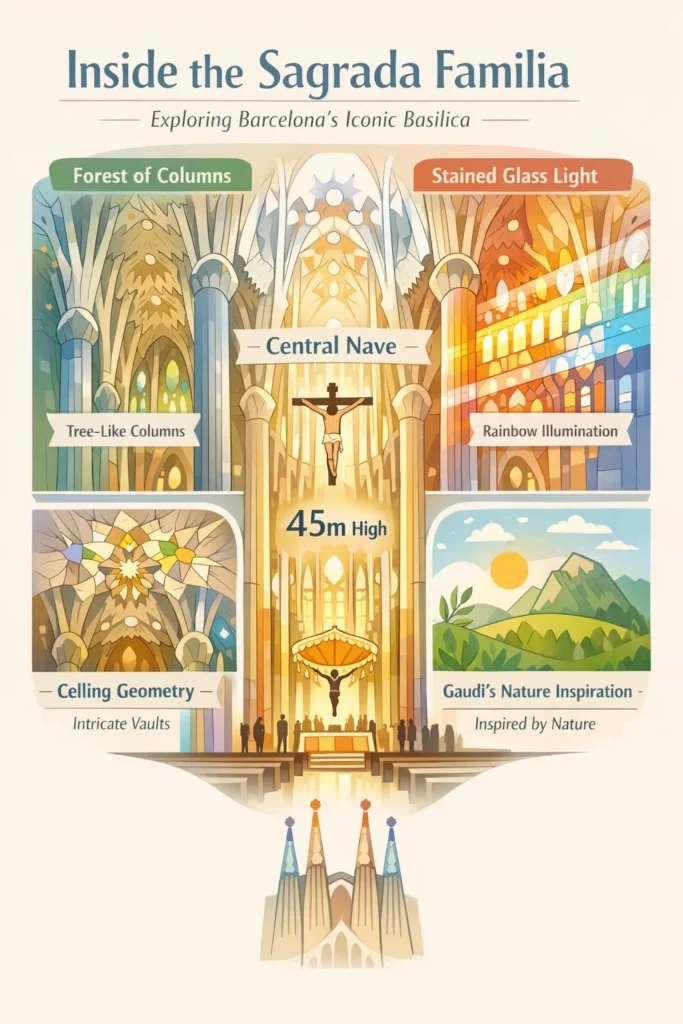
- The central area where the churchgoers gather is called the nave. It is the central area of the church. It is a huge area, 45 meters high, which gives you a sense of how small you are, but at the same time, it inspires you.
There are no supports on the outside of the church like there are in other older churches. Instead, the designer of the church, Gaudí, came up with a clever idea. He put columns which look like trees.
The columns start off as one, then split into many as they rise up like the branches on a tree. This is a clever idea because it holds up the church, and it looks beautiful too. It is one of the most beautiful buildings ever constructed.
Key Interior Dimensions
| Architectural Element | Measurement | Purpose |
| Central Nave Height | ~45 meters | Creates dramatic vertical space |
| Side Aisles Height | ~30 meters | Maintains structural balance |
| Column Grid | 7.5 meters | Provides architectural harmony |
| Number of Aisles | 5 | Traditional basilica layout |
| Construction Start | 1882 | Beginning of project |
Even though the structure is built primarily from stone, the interior feels surprisingly light and harmonious.
Visitors frequently remark that the building feels alive because the shifting sunlight constantly transforms the atmosphere.
History of the Sagrada Familia Interior
The story of the basilica started in 1882.
It started when construction commenced under the guidance of architect Francisco de Paula del Villar.
* The church was to be a neo-Gothic church.
- The concept was simple.
- But things changed in 1883.
- The project was assigned to Antoni Gaudí.
- The concept of the church was completely overhauled.
- Gaudí did not wish to build another cathedral.
- The church was to reflect the concept of nature.
The concept of God’s design.
- Gaudí overhauled every aspect of the church.
- He worked on the columns, ceilings, and facades.
- He worked on it for over 40 years.
- For 15 years, he concentrated solely on this project.
- But his work came to a halt in 1926.
- Gaudí was hit by a tram in Barcelona.
- Died due to his injuries.
- The construction was not halted.
- It kept going.
- The basilica is one of the ongoing architectural projects in history.
The project of the basilica is still ongoing.
The construction of the basilica is still going on.
Important Historical Milestones
| Year | Event |
| 1882 | Construction begins |
| 1883 | Gaudí takes over the project |
| 1926 | Gaudí dies |
| 2010 | Basilica consecrated by Pope Benedict XVI |
| 2030s | Estimated completion period |
The basilica has also gained international recognition.
Parts of Gaudí’s architectural work, including elements of the basilica project, are protected by the UNESCO World Heritage program.
Architecture of the Interior Designed by Gaudí
The inside of the Sagrada Família is said to be one of the amazing things about modern buildings.
He used shapes, engineering, art, and nature to design a space that was both scientific and spiritual at the time.
Gaudí did not use copies of building styles.
Gaudí invented a new style for designing buildings.
The Forest of Columns
One of the things about Sagrada Familias inside is the tree-like columns.
The columns do not reach the ceiling like a normal column does.
Gaudís columns have a different style compared to the usual column.
Each column does the following:
- It starts on the floor
- It has a split
- It has branches
- It has branches that stretch out like a tree
- It holds up the ceilin
- It looks like you are walking through a forest made of trees.
- It looks like you are walking through a forest.
- The columns help to distribute the weight of the building well.
- This keeps the building strong.
- It allows the building to have a lot of open space.
- The columns of the Sagrada Familia look like a tree trunk.
- The columns hold up the ceilin.
The columns of the Sagrada Familia are like a tree trunk.
The columns make the Sagrada Familia special.
Materials Used for the Columns
Gaudí selected different stone materials depending on the structural load each column needed to support.
| Material | Purpose |
| Granite | Primary load-bearing columns |
| Basalt | Additional structural support |
| Porphyry | Central supporting columns |
| Sandstone | Decorative architectural elements |
These stones create subtle variations in color and texture throughout the interior.
The result is a space that feels rich, layered, and visually dynamic.
The Central Nave
The main part of the church is called the nave. The nave is the center of the church. If you stand in the center of the nave, you can see how big and beautiful it is. From there, you can see all of the features of the basilica, such as:
- The columns that branch out
- The ceiling, which is made up of shapes
- The stained windows that glow
- The altar area, which is very dramatic
The basilica is different from other old churches. Old churches have thick walls. Gaudís basilica is different. The basilica has columns that help support it. This makes the inside of the basilica very calm and peaceful. The inside also feels very light. The inside of the central nave and the whole basilica can also feel very inspiring. The central nave is really something to see. The design of the basilica is very special.
The Ceiling and Vaults
Another wonderful thing with the inside of the basilica is the ceiling.
Gaudí used shapes to create vaults which are very beautiful and strong.
The shapes are:
- Hyperboloids
- Paraboloids
- Helicoids
- These shapes help the building in the following ways:
- They distribute the weight evenly
- They make the framework of the building stronger
- They allow the building to receive natural light
- The shapes of the ceiling resemble the natural covering of leaves on the branches of a tree.
- This is a representation of what Gaudí wanted to show the world: the natural world has the ideas, for buildings, and he used the basilica to demonstrate it with the basilica being a wonderful example.
The basilica has a natural design which makes it look natural, and the basilica’s design is wonderful.
The Main Altar
- The main altar is at the end of the nave. It is under the basilicas apse.
- The main altar has a cool sculpture of Christ on the cross above it.
- The sculpture of Christ on the cross looks like it is floating in the air. This makes you look up.
- This makes you think about the connection between the earth and heaven.
- The main altar is where they hold the church services, in the basilica. The main altar is the center of these services.
The Crypt
- There is a really old crypt underneath the bottom part of the building. This is one of the parts of the building.
- This crypt was completed before Antoni Gaudí was asked to make changes to the rest of the project.
- This crypt is quite different from the one upstairs. It looks like a church.
- This crypt is quite unique because Antoni Gaudí is buried there.
Many people like to come to the crypt to have a moment of peace after they have seen the beautiful interior of the basilica.
The Stained Glass of the Sagrada Familia
Maybe the most amazing thing is, inside the basilica, is that it has really cool stained-glass windows.
These windows take the sun’s light and turn it into light that illuminates the whole building.
When light shines on the stone columns and floor, they light up with colorful hues that change constantly.
It is always different, changing a great deal during the day.
Meaning of the Colors
The stained-glass design follows a symbolic color scheme representing different spiritual ideas.
| Color Zone | Symbolism |
| Blue & Green | Birth and harmony |
| Yellow | Energy and daylight |
| Red & Orange | Passion and sacrifice |
| Purple | Reflection and devotion |
Together, these colors represent a symbolic journey from creation toward spiritual enlightenment.
How the Light Changes During the Day
One reason the basilica interior feels so dynamic is the continuous movement of sunlight.
Morning Light
- The morning is quite nice. Sunlight enters through the window on the east side.
- The room is colored nicely with colors such as Blue and also Turquoise and Soft green.
- The colors of Morning Light make everyone happy when they come to see them.
Afternoon Light
- In the afternoon, sunlight enters through the window on the side.
- The room is filled with colors such as Red and also Orange and Golden amber.
- The colors of Afternoon Light are quite cool. Photographers love to take pictures.
Symbolism Inside the Basilica
Gaudí believed that a building should teach us things about the world or about God.
As a result of his belief, there are many symbols inside the basilica.
**Religious Symbolism**
The basilica has many symbols of ideas that are part of the Christian religion.
For example:
- The columns are symbols of the people who started the Christian church.
- The carvings on the walls are symbols of stories from the Bible.
- The statues are symbols of the story of Jesus Christ.
- Every single thing inside the basilica was put there to make us think about things.
**Mathematics and Geometry**
Gaudí loved math.
He used many mathematical symbols inside his building.
These symbols are:
- different types of curves that move up and down.
- arches that are shaped like a U.
- columns that twist around like a spiral.
- These symbols are not only nice to look at. They also help keep the building standing.
**Inspiration from Nature**
- Gaudí made an interesting statement.
- He said, “The great book that we can always read is the book of Nature.”
- What he meant by this is why the inside of his church looks like a forest or a garden, not a church.
- Gaudí learned many things from nature. Nature was his teacher.
What to See Inside the Sagrada Familia
If you walk around Sagrada Familia from inside, there are a number of things that you should see.
1. The Tree Columns
These pillars are really famous. The pillars make you feel like you are inside a forest.
These pillars are among the things that are photographed most in the world because they are really beautiful.
2. The Giant Stained Glass Windows
The stained glass windows make the church look like a colorful picture that changes every hour.
Every hour of the day is different because of the light.
3. The Suspended Crucifix
The crucifix that is suspended in the air above the altar is really powerful to look at.
4. The Monumental Organ
Sagrada Familia has one of the organs in Spain.
When they play the organ during concerts or church services, it is really loud. The sound fills up the whole room.
5. Hidden Architectural Details
If you look around Sagrada Familia, there are a number of small details that you should notice, such as:
- The small symbols that mean something special to the church
- The small flowers and leaves on the wall
- The small patterns on the ceiling
- These small things are really cool. They make you happy when you find them because you took your time to look around Sagrada Familia.
The Experience of Visiting the Sagrada Familia Inside
When entering the basilica, it is a very emotional experience.
The size and beauty of the basilica are so great that even if a person does not go to church, when entering the church, the space inside, the colors, and the light will make them feel amazed.
The way the basilica is designed, the size, the shape, the light, will make you feel something very strong.
- Best Time to Enter
- Morning Visit
- Advantages:
- There are people around
- The colors from the stained glass windows look cooler
- It is very quiet inside
- Afternoon Visit
- Advantages:
- The sun light is golden, looks nice
- The light is good for taking pictures
The colors reflecting off things are very intense. The colors of the basilica are really beautiful, intense reflection of the colors of the basilica.
How Long Does the Visit Take?
Most visitors spend around 1–2 hours exploring the interior.
If you also visit the towers or museum exhibitions, your visit may last 2–3 hours.
Photography Tips
For the best interior photographs:
- Visit early morning or late afternoon
- Use a wide-angle lens
- Look upward to capture the columns
- Photograph stained glass during strong sunlight
Tripods and flash photography may be restricted.
Visitor Tips for Travelers in Europe
Many travelers visiting Europe include the basilica in larger travel routes that also feature cities such as:
- Madrid
- Paris
- Rome
However, many experienced travelers say the interior of the Sagrada Família stands apart from other European cathedrals.
Comparison with Famous European Cathedrals
| Cathedral | Country | Style |
| Sagrada Familia | Spain | Modernist + Organic |
| Notre-Dame Cathedral | France | Gothic |
| St. Peter’s Basilica | Italy | Renaissance |
| Cologne Cathedral | Germany | Gothic |
Gaudí’s design stands out because it blends art, science, nature, and spirituality into a single structure.
Pros and Cons of Visiting the Interior
Pros
- The interior design is one of a kind.
- The natural light is amazing.
- There are symbols with deep meaning.
- It has a connection to UNESCO heritage.
- Visiting here is both educational and inspiring.
Cons
- The tickets are pricey.
- It gets very crowded during peak tourist season.
- Some areas are still, under construction.
Frequently Asked Questions
Yes, I think so. I have heard many people say that inside is much more awesome than outside.
It takes around 1 to 2 hours to visit inside the basilica.
Yes, you can take photos inside. Remember to avoid flash and tripods.
If I were you, I would recommend going early in the morning or late in the afternoon. The light is nice. There are fewer people around.
No, they are still building it. You can see all areas inside.
Conclusion
The inside of the Sagrada Família is really something
It is an unique place to see.
- If you go inside the Sagrada Família basilica, you will find the ideas of Antoni Gaudí.
- The Sagrada Família is full of things, geometric shapes, and spiritual symbols combined together.
- The columns inside the Sagrada Família look like trees, inside a forest, and the stained glass windows shine.
- Every single part of the Sagrada Família has the idea that Antoni Gaudí believed that buildings should look like the world.
- If people are going to go to Barcelona, they should go inside the Sagrada Família.
- Going to the Sagrada Família is not something to do when you are traveling.
- The Sagrada Família is something that you will remember your life because it is one of the most amazing buildings ever made.