Inside of Sagrada Familia Barcelona: Complete Interior Guide to Gaudí’s Masterpiece
- The Sagrada Familia is a building that gives people feelings of amazement and respect.
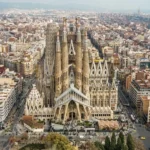
- It is placed in the middle of Barcelona.
- The Sagrada Familia is not a church, but it is indeed a special one.
- It is a reflection of the creativity and intelligence of the person who designed it.
- The Sagrada Familia has unique ideas regarding the way it is designed.
- It is a spiritual place as well.
- Millions of people visit the Sagrada Familia annually.
- They come from all over the world to visit this special plan
No one visits the Sagrada Familia because it is a huge building
More tips
- No one visits the Sagrada Familia because it does not have a special feeling.
- The Sagrada Familia is a special place designed by a genius architect.
- The Sagrada Familia is a real piece of art.
- It is a mixture of math, art, nature, and spirituality.
- It is beautiful and carries deep meaning.
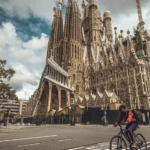
Antoni Gaudí, the genius who designed the Sagrada Familia, wanted this special place to look different from the churches in Europe.
- European churches are huge, dark, and gloomy.
- The Sagrada Familia is full of light, colors, and the beauty of nature.
- Antoni Gaudí called the Sagrada
- The Sagrada Familia is a place where a person can get a feeling of wonder and association with something greater than themselves.
- It is a unique and motivational place to visit.
- This is a guide that will enable you to understand what is inside the Sagrada Familia in Barcelona.
- We will discuss the design of the Sagrada Familia,
- the meaning of the Sagrada Familia
- and the construction of the Sagrada Familia.
You will also get to know how to visit the Sagrada Familia.
After reading this guide,
- you will be able to understand why it is great to visit the Sagrada Familia.
- The Sagrada Familia in Barcelona is a place with a lot of history.
- You will get to learn about the ideas of the Sagrada Familia in Barcelona.
- The Sagrada Familia in Barcelona is a place with structural features.
- This guide will give you insights about the Sagrada Familia in Barcelona
- for the benefit of the people who visit the Sagrada Familia, in Barcelona.
- Visiting the Sagrada Familia is an experience you will not forget.
- The Sagrada Familia is really something to see.
The Visionary Genesis of the Interior
The story of the inside of the Sagrada Familia begins in 1883, when Antoni Gaudí took over the project. The initial plan was to create a Gothic-style church with symmetrical lines, pointed arches, and a very formal layout. Antoni Gaudí did not want to create the building the same way the other architects did before him. They also wanted to create a special kind of building. He wanted to create a building inspired by nature. He believed nature and math could be used to create something special. Antoni Gaudí had a dream of building a place inspired by nature. He believed nature held the answers to building a place that would be beautiful and would work well. So, Antoni Gaudí studied nature by looking at trees, plants, shells, and other objects to get ideas for the Sagrada Familia. He then used these ideas to create a place that would be balanced and harmonious. The Sagrada Familia was unlike other buildings, as they had straight lines and boxy shapes. Antoni Gaudí used nature and math to create something special. He wanted to create a place and worked hard to achieve his dream.
Gaudí’s Guiding Architectural Principles
The inside of Sagrada Familia is very special because it has some very smart ideas that were new back then, and people still use them today when they build things.
1. Shapes That Look Like Things From Nature
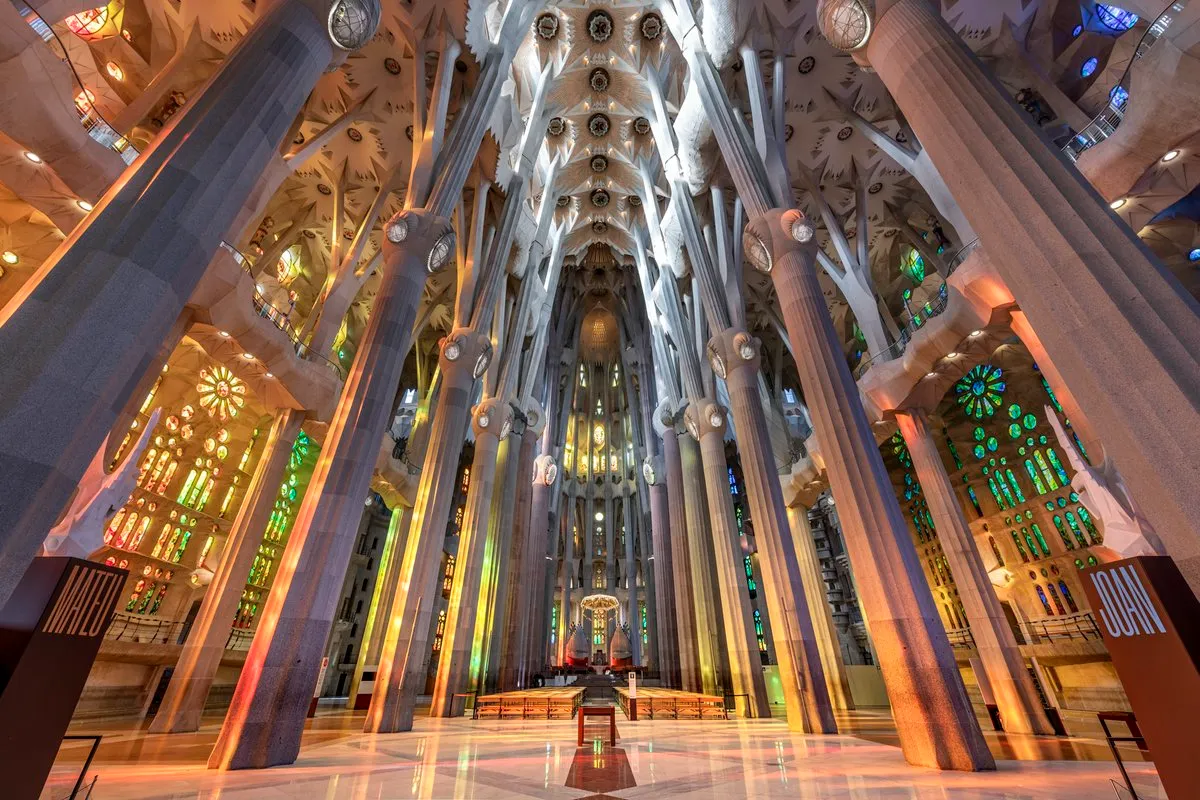
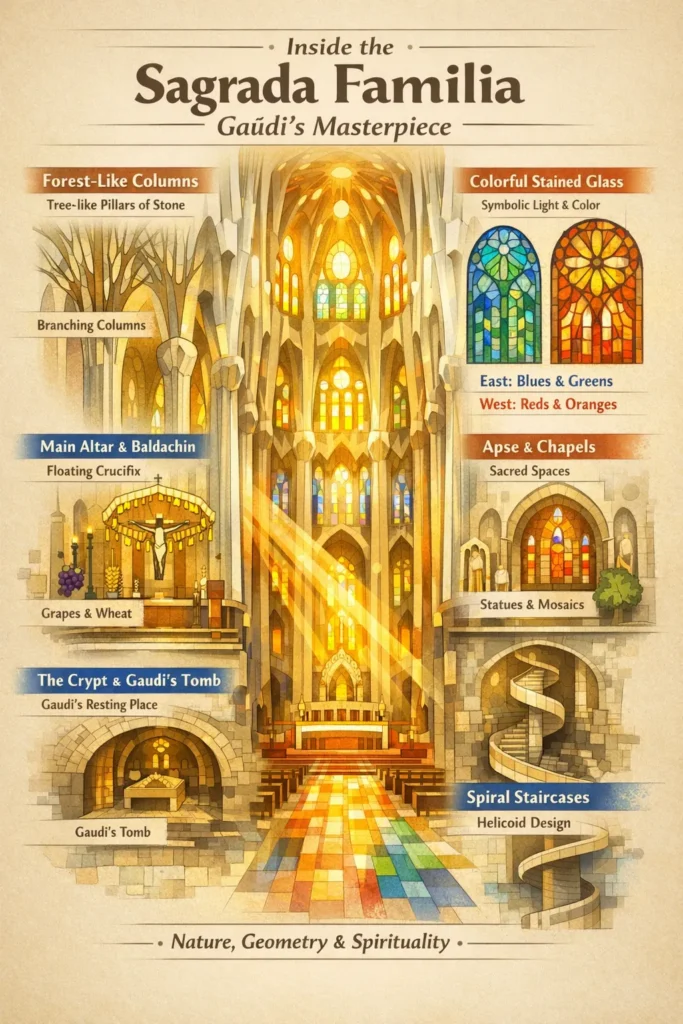
The thing that makes Sagrada Familia special is that it has columns that look like trees. The columns in this place do not look like columns because they branch off as they go towards the ceiling like a tree does. This makes it look like a forest made of stone, which is very cool because it is very beautiful and very strong too.
2. Light That Changes How Things Look
The man who designed this place, Gaudí, believed that light was not only something that helps us see, it was also special. The light that comes through the windows makes a pattern on the floor in all the colors of the rainbow. The different colors mean something to us, such as how we are feeling and what is going on in our life, and they are also very important to our spiritual journey at this place.
3. Geometric Innovation
- The inside of the building has different shapes.
- These shapes include a hyperboloid, paraboloid, helicoid, and spiral.
- These shapes are not just for decoration.
- These shapes are used to distribute the weight.
- This makes the building stable.
- The building does not need support.
- This is different from the Gothic style of building.
4. Religious Symbolism
- Everything in the basilica means something.
- The writings on the walls, the carvings, and the building itself are all symbols of Gaudí’s values.
- Gaudí wanted to encourage people to learn about their faith.
- When people walk through the basilica, they can think about their faith and what it means to them.
- Gaudí’s values are evident in all parts of the building.
What Makes the Interior Exceptional?
Although European cathedrals like Notre-Dame Cathedral and St. Peter’s Basilica are renowned for their grandeur, the Sagrada Familia interior departs radically from conventional sacred spaces. Here, the ambiance is luminous, expansive, and organically integrated—more akin to a living ecosystem than a static monument.
| Feature | Description | Uniqueness |
| Tree-like columns | Branch upward like trees | Structural + symbolic integration |
| Color-changing light | Stained glass transforms hues | Interior evolves with time of day |
| Organic geometry | Hyperboloid & spiral forms | Rarely used in traditional churches |
| Open, airy nave | Bright, spacious atmosphere | Contrasts dark Gothic interiors |
| Symbolic ornamentation | Extensive religious motifs | Spiritual storytelling in architecture |
First Impressions Upon Entry
When you go into the basilica, you are entering a place that is quite different from what you would normally expect.
- The Sagrada Familia has a high ceiling. In fact, the main part of the church goes over 45 meters high. This is quite amazing.
- The light that enters the Sagrada Familia is quite colorful. In fact, the light enters the church through the stained windows. As a result, the colors on the walls and columns change frequently.
- The columns of the Sagrada Familia look as if they are a forest of trees. In fact, they branch out. They look as though they are growing. As a result, the Sagrada Familia looks quite special. They make you look upwards.
The design of the Sagrada Familia with the high ceilings, the colorful light, and the columns that look as though they are trees makes the inside of the Sagrada Familia one of the most amazing places of worship, anywhere in Europe.
The Forest-Like Columns of the Nave
The basilica has a cool system of columns branching out, which is amazing from an engineering point of view, and it also has a lot of meaning.
The columns of the basilica do several things:
- They help to distribute the weight of the building efficiently
- They hold up the ceiling with lots of curves
- They mean that the basilica does not require much support from the outside
- The columns of the basilica also have a lot of meaning:
- They symbolize the idea of rising up to something
- They symbolize how what happens on earth relates to something, than us
- They symbolize how nature and faith can work together in harmony
- The basilica is made of different materials:
- Granite is used to make the main columns which hold up the building
- Basalt is used to make the building stronger
Porphyry is used to make the building look nice, as well as to hold it up
These materials make the basilica look very nice, and they are also very helpful in keeping it up.
The columns of the basilica are very important. The basilicas materials are very nice.
The Enchanting Stained Glass
Unlike traditional ecclesiastical windows, which often emphasize narrative scenes, Gaudí designed his stained-glass panels to transform interior light dynamically:
Directional Color Philosophy
| Side | Palette | Symbolism |
| East (Nativity) | Blues & Greens | Life, hope, renewal |
| West (Passion) | Reds & Oranges | Sacrifice, resurrection |
Morning light creates tranquil blue-green hues, while evening sun bathes the interior in fiery golds and reds, making each visit visually unique.
The Main Altar and Baldachin
- The heart of the basilica is its altar. It also has a covering at the top. Some of the important features to note are:
- The crucifix floating in the air
- The pictures of grapes and wheat placed on the altar. These are very important to the people who come to church. These remind us of a ceremony.
- The altar has many designs. This reminds us that God is with us.
- The altar is beneath a tower. This tower has a picture of Jesus Christ on it. This tower will be the thing sticking out of the basilica when it is complete.
The Apse and Chapels
Behind the altar, there is an area known as the apse. This area is half a circle. This area is really beautiful with sculptures and colored windows and words written on the walls. The apse has seven chapels built around it. Each one represents a different saint. The apse represents a destination for spiritual people. This area is very important to them.
The Crypt and Gaudí’s Tomb
Underneath the part of the church, there is a crypt. This area is the oldest part of the basilica. This part of the basilica was built before Gaudí changed the design. This area has a number of chapels. Antoni Gaudí’s tomb is located here. This area is a quiet area for people to think and reflect. This area is quite a contrast to the large area above it.
Choir Loft and Musical Architecture
Gaudí’s intention for the basilica was for it to be full of music. The choir loft will be big enough to hold over 1,000 singers. The design allows for perfect acoustics.
- The curved surfaces allow for resonance, which makes the sound louder
- The high platforms ensure that the sound will go everywhere
- The way the sound works together allows for music to sound really good.
Geometric Ingenuity and Engineering
The interior’s structural brilliance stems from Gaudí’s innovative use of geometry:
- Hyperboloids: Efficient weight-bearing forms
- Paraboloids: Light-guiding and structural stability
- Helicoids: Spiral elegance with functional support
- Spiral Staircases: Connect floors while reinforcing design
This natural geometry eliminates the need for flying buttresses typical in Gothic churches, illustrating Gaudí’s forward-thinking integration of science and art.
Hidden Gems Visitors Often Miss
Beyond grand architectural statements, the interior harbors subtle details:
- Sculpted fruits for abundance
- Stars for heaven
- Animals referencing biblical narratives
- Multilingual religious inscriptions
These elements demonstrate Gaudí’s belief that architecture could communicate spiritual truths in intricate, multi-layered ways.
Light as the Interior’s Pulse
Sunlight animates the basilica, altering perception with time:
| Time | Lighting Effect |
| Morning | Cool blues & greens |
| Midday | Bright neutral tones |
| Evening | Warm reds & golds |
For photographers, architectural enthusiasts, and contemplative visitors, sunset provides a particularly dramatic and memorable experience.
Is It Worth Visiting Inside Sagrada Familia?
Absolutely. While ticket prices and crowds may cause hesitation, the interior experience is widely regarded as unparalleled:
- Witness Gaudí’s genius firsthand
- Experience breathtaking, evolving light
- Explore one of the world’s most distinctive churches
- Interpret profound symbolic narratives
Even among Europe’s iconic religious landmarks, the Sagrada Familia interior occupies a category entirely its own.
Practical Visitor Guidance
Optimal Visiting Times
- Morning (9–11 AM): Soft blue light
- Late Afternoon: Dramatic golden-red illumination
Key Tips
- Purchase tickets online in advance
- Allow 1–2 hours to explore fully
- Observe ceiling patterns frequently
- Don’t skip the crypt or museum
- Combine with other Barcelona attractions
| Pros | Cons |
| Unique architecture | Ticket cost |
| Dynamic stained glass | Crowds at peak times |
| Historical significance | Exterior construction ongoing |
| Europe’s top landmark | Limited quiet moments |
FAQs About Inside Sagrada Familia Barcelona
It will take you about an hour or two to visit the inside of the museum and the crypt.
The inside of the Sagrada Familia was finished in the year 2010. The Pope, Benedict XVI, came to complete the inside of the Sagrada Familia. However, the tall towers are still under construction.
Yes, you can visit the tomb of Antoni Gaudí. The tomb is in the crypt of the Sagrada Familia.
The best time to visit the stained glass windows is in the afternoon. At this time, the inside of the Sagrada Familia is filled with the warm colors of the sun, red and orange.
Yes, the Sagrada Familia is one of the famous places in Spain. It is a very
Conclusion
When you go inside Sagrada Familia, it’s like going on a journey where you can see architecture, learn about faith, and discover human creativity.
Sagrada Familia has a design that incorporates natural shapes and symbols to narrate stories.
- Lighting has been used in such a way that it produces a beautiful ambiance.
- This has been made possible by Antoni Gaudí, who designed Sagrada Familia.
- Millions of people are amazed by it every year.
- When you go inside Sagrada Familia, you can see how people, nature, spirituality, and mathematics come together.
- Every small detail will make you think, appreciate, and feel amazed.
- If you are traveling to Spain or going to various places in Europe, you must go inside Sagrada Familia.
- It’s a must-see place.
This experience will surely be with you.
Sagrada Familia is a place where you can see human creativity and faith.
When you go to this place, you will feel a sense of connection.
Sagrada Familia inspires people with its design and beauty.
This is a place where you can learn and feel amazed, at the same time.