Introduction
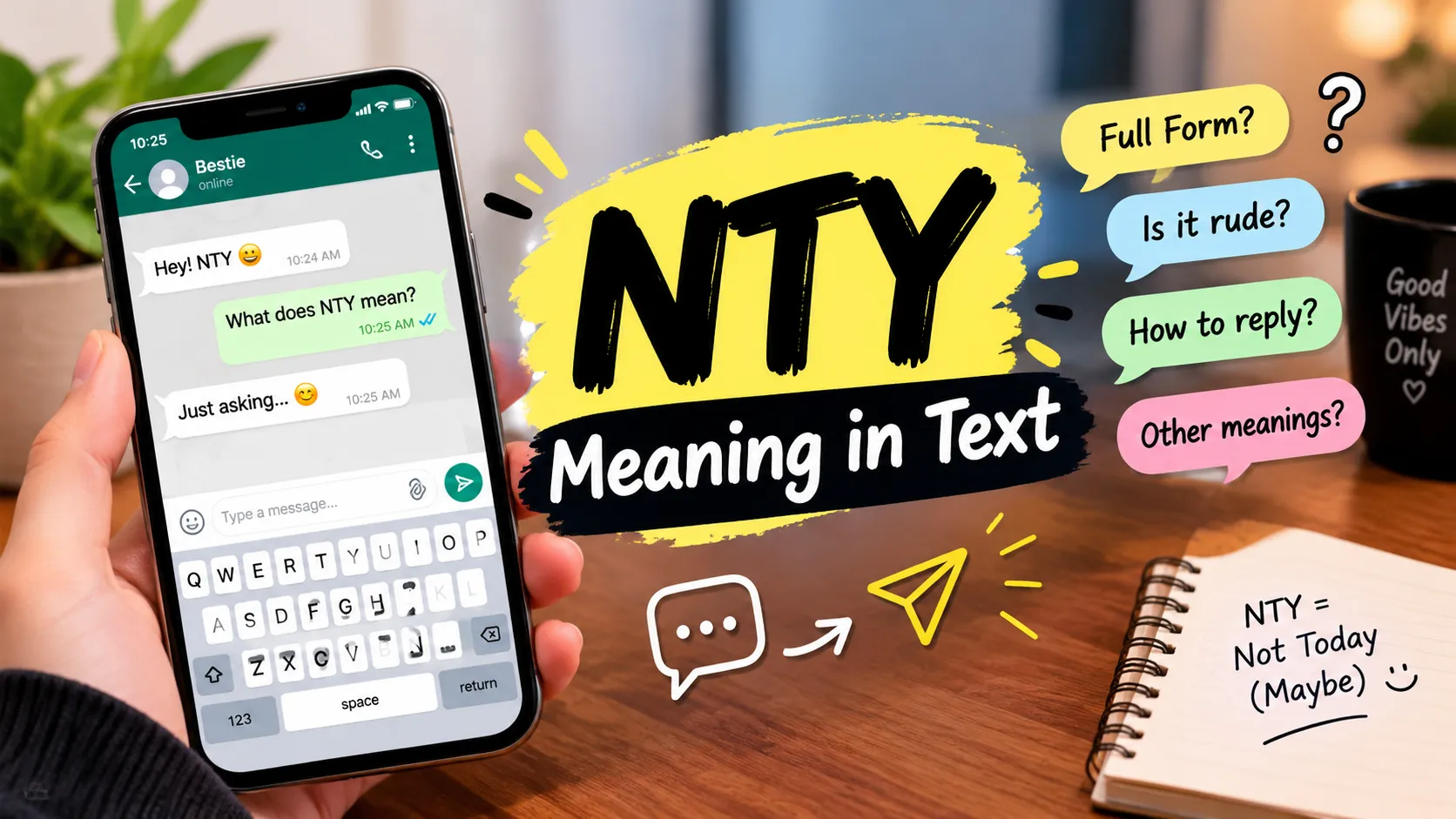
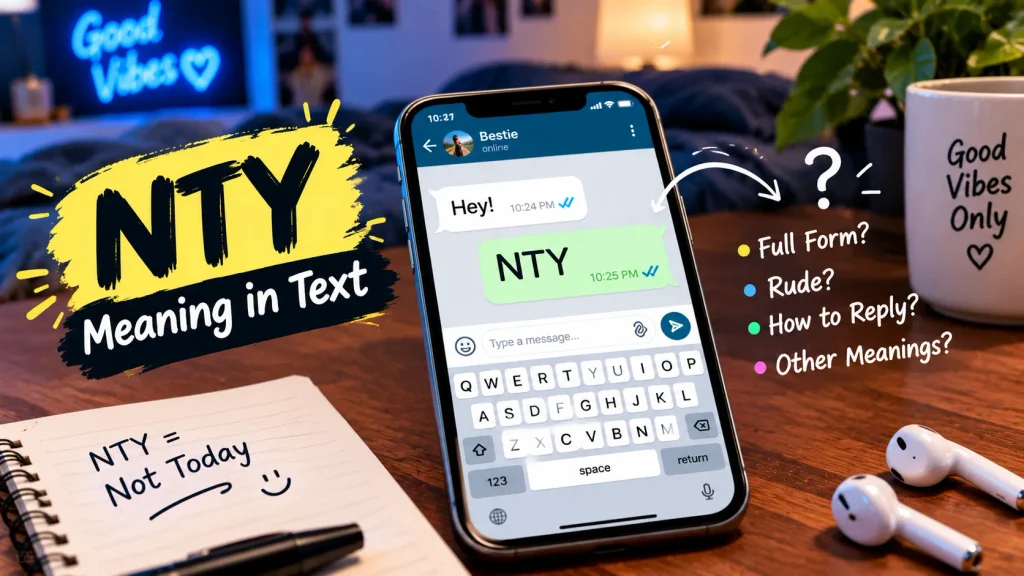
Have you received a message that simply says “NTY” and wondered what it means? In texting, NTY usually stands for “No, Thank You.” People use this abbreviation to decline an offer, invitation, suggestion, or request without typing the complete phrase.
You might see NTY In Text Messages, Instagram DMs, Snapchat chats, WhatsApp groups, gaming conversations, and other online interactions. Although it is a short way to say no, its tone can vary depending on the situation.
For example, if a friend asks, “Want to get some coffee?” you could reply, “NTY, I already had some.” This communicates that you do not want coffee while acknowledging the offer.
In this guide, you will discover the NTY meaning in text, its full form, common uses, real conversation examples, whether it sounds rude, and how to respond when someone sends it to you.
What Does NTY Mean in Text?
NTY means “No, Thank You” in text messages and online conversations. It is a casual abbreviation people use when declining something they do not want or need.
Instead of typing “No, thank you,” someone can write “NTY” to communicate the same basic message more quickly.
For example:
Person A: Do you want another slice of pizza?
Person B: NTY, I’m full.
Here, Person B is politely declining the offer. The abbreviation keeps the response short while making the person’s decision clear.
NTY is generally used in informal communication. In a professional email or an important conversation, writing the complete phrase may sound more appropriate.
NTY Meaning at a Glance
| Detail | Explanation |
| Abbreviation | NTY |
| Full form | No, Thank You |
| Category | Texting abbreviation and internet slang |
| Main meaning | Declining an offer or suggestion |
| Typical tone | Brief, casual, and potentially polite |
| Common settings | Text messages, DMs, gaming chats, and online groups |
The most important thing to remember is that NTY usually communicates a refusal. However, the abbreviation alone does not tell you whether the sender is annoyed, uninterested, or simply responding quickly.
What Does NTY Stand For?
NTY stands for No, Thank You. Each letter represents the first letter of a word in the phrase:
- N: No
- T: Thank
- Y: You
People use this short form to make digital conversations quicker and more convenient.
For example:
Friend: Should I order you something to eat?
You: NTY, I’ve already eaten.
The response declines the offer without requiring a long explanation.
NTY is also related to other common abbreviations, such as TY, which means “Thank You,” and NP, which means “No Problem.” However, these expressions serve different purposes.
What Does NTY Mean in Slang?
As internet slang, NTY is a shortened way of saying “No, Thank You.” It usually indicates that someone is declining an offer, invitation, suggestion, or request.
The abbreviation is useful in informal conversations because it communicates a decision with just three letters.
For example:
Friend: Want to join our game tonight?
You: NTY, I’m taking a break.
In this conversation, NTY is a straightforward refusal. The additional explanation makes the response sound more conversational.
Although NTY can be considered texting slang, its meaning is relatively literal. It does not usually represent a hidden message or a special expression of emotion.
How Is NTY Used in Text Messages?
People use NTY in several everyday situations. Understanding the context can help you interpret the message correctly.
1. Declining an Invitation
NTY can be used when someone invites you somewhere, and you do not want to attend.
Example:
Alex: Are you coming to the party tonight?
Sam: NTY, I’m staying home.
Sam is declining the invitation. The response does not necessarily mean Sam dislikes Alex or the other people attending.
2. Refusing an Offer
Someone might offer food, drinks, assistance, or something else you do not need.
Example:
Mia: Would you like some coffee?
Emma: NTY, I just had a cup.
Emma is politely declining the offer.
3. Turning Down a Suggestion
NTY is also useful when you do not want to follow someone’s suggestion.
Example:
Friend: Let’s watch a horror movie.
You: NTY, those movies scare me!
The response communicates a preference without making the conversation unnecessarily serious.
4. Declining an Online Trade
In gaming communities and online marketplaces, people may use NTY to reject a trade or purchase offer.
Example:
Player A: Want to trade your rare item for mine?
Player B: NTY.
So Player B is declining the proposed trade.
5. Refusing an Unwanted Offer
NTY can help someone turn down an unwanted sales pitch or request.
Example:
Seller: Would you like to upgrade to our premium package?
Buyer: NTY, I’m not interested.
The buyer is expressing a clear refusal.
Real Examples of NTY in Conversations
These examples show how the abbreviation can be used naturally in different situations.
Example 1: Making Plans
Friend: Want to grab dinner after work?
You: NTY, I have plans tonight.
Meaning: You are declining the invitation.
Example 2: Offering Food
Sibling: Do you want some fries?
You: NTY, I’m full 😊
Meaning: You do not want any fries. The emoji makes the short reply feel warmer.
Example 3: Gaming Chat
Player 1: Want to join our team?
Player 2: NTY, I’m playing with friends.
Meaning: The player is declining the invitation to join the team.
Example 4: Shopping Online
Seller: I can offer you this item for $20.
Buyer: NTY, that’s outside my budget.
Meaning: The buyer is declining the offer.
Example 5: Offering Help
Friend: Need help with your homework?
You: NTY, I’ve already finished it.
Meaning: You appreciate the offer but do not need assistance.
Example 6: A Personal Invitation
Person A: Would you like to go out with me this weekend?
Person B: NTY, but I appreciate you asking.
Meaning: Person B is declining the invitation while acknowledging the other person’s effort.
Example 7: Group Chat
Friend 1: Who wants to go shopping tomorrow?
Friend 2: NTY, I need to study.
Meaning: Friend 2 is opting out of the proposed activity.
These examples illustrate the central meaning of NTY: declining something. The exact tone comes from the surrounding words and the relationship between the people communicating.
Is NTY Rude or Polite?
NTY is not automatically rude. Because it stands for “No, Thank You,” it can communicate a polite refusal. However, a very short message may sometimes sound blunt or dismissive.
Consider these two responses:
Brief: “NTY.”
Warmer: “NTY, but thanks for thinking of me!”
Both decline the offer, but the second makes the appreciation more explicit.
NTY may sound polite when:
- The conversation is casual and friendly.
- Both people regularly use texting abbreviations.
- The sender adds a thank-you, Explanation, or friendly emoji.
- The refusal is straightforward but respectful.
It may sound blunt when:
- It appears as the only response to a thoughtful invitation.
- The conversation is serious or emotionally sensitive.
- The sender is already expressing frustration.
- The recipient expects a more detailed answer.
If you receive NTY, avoid assuming the sender is angry based on the abbreviation alone. Look at the conversation as a whole.
What Does NTY Mean on Snapchat, Instagram, TikTok, and WhatsApp?
NTY generally has the same meaning across social media platforms: “No, Thank You.” The context may change, but the basic interpretation usually remains the same.
NTY Meaning on Snapchat
On Snapchat, someone might use NTY in a private chat or group conversation to decline an invitation or suggestion.
Example:
Friend: Want to meet up after school?
You: NTY, maybe tomorrow.
The reply declines the current plan without necessarily rejecting plans.
NTY Meaning on Instagram
On Instagram, NTY may appear in direct messages or comments when someone declines an invitation, collaboration, or offer.
Example:
Creator: Want to collaborate on a post?
You: NTY, I’m focusing on other projects.
The response communicates that the person does not want to collaborate.
NTY Meaning on TikTok
On TikTok, NTY can be used in comments or direct messages to reject a suggestion or indicate that someone does not want to participate in something.
Example:
Comment: You should try this challenge!
Reply: NTY, I’ll pass!
The reply declines the suggestion in a casual way.
NTY Meaning on WhatsApp
On WhatsApp, NTY may appear in personal messages and group chats when someone turns down an offer or proposed activity.
Example:
Friend: Should I bring you some snacks?
You: NTY, I’m good.
The person is declining the offer.
NTY Meaning on Discord
On Discord, NTY can be used in gaming chats, community servers, and private messages.
Example:
Player: Want to join our next match?
Reply: NTY, I’m logging off.
The abbreviation communicates a quick refusal.
These examples illustrate possible uses rather than platform-specific Definitions. NTY does not have a different standard meaning on each app.
What Does NTY Mean From a Girl or a Guy?
NTY generally means “No, Thank You,” regardless of who sends it. The sender’s gender does not automatically change the abbreviation’s definition.
When a Girl Sends NTY
If a girl responds with NTY after you offer something or invite her somewhere, she is generally declining that particular offer.
Example:
You: Want to get coffee this afternoon?
Her: NTY, I’m busy today.
She is declining the invitation. The message alone does not establish whether she dislikes you or has no interest in plans.
If the conversation is romantic, respect the answer rather than repeatedly asking for a different response.
When a Guy Sends NTY
If a guy sends NTY, he is usually declining an offer, suggestion, or invitation.
Example:
You: Want to play football this evening?
Him: NTY, I have work to finish.
His message indicates that he does not want to participate in that plan.
Does NTY Mean Someone Is Not Interested in You?
Not necessarily. NTY tells you that someone is declining something, but it does not explain every reason behind the decision.
The person might be busy, tired, unavailable, or simply Uninterested in the specific activity. In a romantic situation, consider the wider conversation and respect any clear refusal.
How to Reply When Someone Texts NTY
Your response should depend on the situation. In many cases, a short and friendly reply is enough.
Friendly Replies
Use these when someone declines an ordinary offer or invitation:
- “No worries!”
- “That’s totally fine.”
- “All good!”
- “Maybe another time.”
- “No problem at all.”
Example:
You: Want to grab lunch?
Friend: NTY, I already ate.
You: No worries!
Polite Replies
These responses work well when you want to acknowledge someone’s decision respectfully:
- “Okay, thanks for letting me know.”
- “That’s fine, I understand.”
- “No problem, have a great day!”
- “Sure, I appreciate the response.”
Replies to a Declined Invitation
If someone declines your invitation, you can respond without putting pressure on them:
- “No worries, maybe next time.”
- “That’s okay. Have a good one!”
- “All good, thanks for letting me know.”
- “Sure, enjoy your day!”
Replies to a Declined Offer
When someone does not want what you offered, you can keep your reply simple:
- “Okay!”
- “Sure, no problem.”
- “Got it!”
- “Let me know if you need anything later.”
Do You Always Need to Reply to NTY?
No. If the conversation has naturally ended, you do not need to send another message.
For example:
You: Want some coffee?
Friend: NTY, thanks.
You can leave the conversation there unless you have something else to discuss.
NTY vs. No Thanks, TY, NP, and NYT
NTY can be confused with other abbreviations because they appear in similar conversations. Their meanings, however, are different.
| Term | Meaning | Main purpose |
| NTY | No, Thank You | Declining an offer |
| No thanks | No thanks | Declining something in plain language |
| TY | Thank You | Expressing gratitude |
| NP | No Problem | Indicating that something is okay |
| NYT | Often The New York Times | Referring to the newspaper or another context-specific term |
NTY vs. No Thanks
NTY is a shortened version of “No, Thank You.” Both expressions generally communicate the same message.
- “NTY, I’m busy.”
- “No thanks, I’m busy.”
Both decline an offer.
NTY vs. TY
NTY means “No, Thank You,” while TY means “Thank you.”
Example:
Friend: Want some help?
Reply A: NTY, I can manage.
Reply B: TY, I appreciate it.
The first response declines assistance, while the second expresses gratitude.
NTY vs. NP
NP stands for “No Problem.” It is often used to reassure someone that something is acceptable or not an issue.
Example:
Person A: Sorry I’m late.
Person B: NP.
In contrast, NTY is used to decline an offer.
NTY vs. NYT
NTY usually means “No, Thank You” in texting. NYT often refers to The New York Times, although its meaning can vary by context.
For example:
- “NTY, I don’t need another one.” — Declining an offer.
- “I read an NYT article.” — Referring to the newspaper.
Reading the surrounding message helps distinguish the two.
Why Do People Use NTY Instead of Writing No, Thank You?
People use NTY because it makes informal digital conversations shorter and quicker.
Common reasons include:
- Faster communication: Typing three letters takes less time than writing the complete phrase.
- Convenient shorthand: The abbreviation fits naturally into short replies.
- Familiarity: People who regularly use texting slang may recognize it immediately.
- Concise refusals: It communicates a decision without a lengthy explanation.
- Casual conversation: It suits informal chats where complete sentences are not always necessary.
However, abbreviations are not always the best choice. If you are declining a formal invitation, responding to a customer, or discussing something sensitive, a complete sentence may communicate your intentions more clearly.
When Should You Use NTY?
NTY is generally suitable for informal conversations with friends, family members, gaming partners, and people who understand texting abbreviations.
You can use it when declining:
- An invitation to meet up.
- An offer of food or drinks.
- A suggestion you do not want to follow.
- An invitation to join an online game.
- A trade or purchase offer.
- A casual request you cannot or do not want to accept.
When Should You Avoid NTY?
Consider writing the complete phrase when communicating with a manager, teacher, client, customer, or someone you do not know well.
For example, instead of replying “NTY” to a professional invitation, you could write:
“Thank you for the invitation, but I won’t be able to attend.”
This communicates the same basic decision in a more complete and professional way.
Similarly, when someone has made a personal effort to help you, adding a brief explanation or expression of gratitude can make your response feel more considerate.

- Related To Another Article: https://visitespanly.com/rn-meaning-in-text/
People Also Ask
NTY means “No, Thank You.” It is a common abbreviation used to decline offers, invitations, suggestions, and requests in casual digital conversations.
The full form of NTY is “No, Thank You.” Each letter represents the initial of a word in the phrase.
Yes. NTY is a texting abbreviation and internet slang expression used in informal online communication.
Not necessarily. NTY can sound polite, neutral, or blunt depending on the situation. Additional words or a friendly emoji can make the refusal sound warmer.
Conclusion
NTY means “No, Thank You” in texting and online communication. People use it to decline invitations, offers, suggestions, and requests without typing the entire phrase.
Although the abbreviation is straightforward, its tone can vary depending on the conversation. It may sound friendly and polite in a casual chat, while a standalone response can sometimes feel abrupt.
If someone sends you NTY, focus on what they are declining, respect their decision, and reply naturally if necessary.
Now that you understand the NTY meaning in text, you can recognize the abbreviation in everyday messages and use it appropriately in your own conversations. Explore more texting abbreviations on Wordnesty to understand other expressions you encounter online.